



What is the design concept behind solar-powered landscape seating?
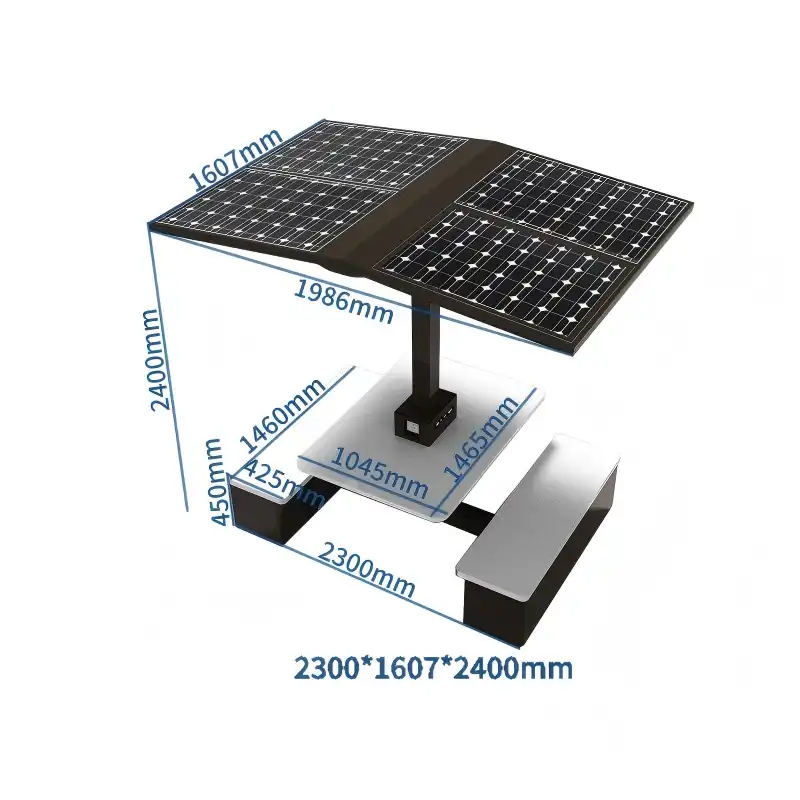
Solar-powered landscape seating represents a transformative shift in how cities and commercial spaces approach public infrastructure. At its core, the design concept integrates Smart seats with smart panels roofs—a seamless fusion where photovoltaic technology meets functional outdoor furniture. This approach eliminates dependency on grid electricity while delivering advanced features like device charging, ambient lighting, and IoT connectivity. The canopy roof harvests solar energy throughout the day, storing power in integrated battery systems to ensure 24/7 operation. This self-sustaining design aligns perfectly with contemporary sustainability mandates and smart city initiatives, making it indispensable for forward-thinking procurement managers.
Understanding Solar-Powered Landscape Seating: Concept and Technology
Core Design Philosophy
The idea behind solar-powered seating combines functionality for the user with care for the environment. Bench designs from the past only did one thing, but today's cities need infrastructure that leaves a mark. By building renewable energy technology right into the structures that hold people, designers create useful hubs that allow people to rest and interact with others in two ways: they can charge their devices, connect to Wi-Fi, or enjoy the light in the evening without using up city power resources.
Technical Architecture of Smart Seats with Smart Panels Roof
These systems are made up of several important parts that work together. Monocrystalline solar modules with outputs ranging from 40W to 100W are usually used on the roof of smart panels because they are very good at turning sunlight into electricity, with efficiency rates above 21%. Deep-cycle lithium iron phosphate (LiFePO4) batteries store energy below the weather-resistant curved glass surface. These batteries can run on their own for three to five days, even when it's cloudy. The sitting structure is made up of galvanized steel frames and powder-coated aluminum profiles. This makes it resistant to rust and meet ASTM B117 salt spray standards while still looking good.
This integration is shown by our Model 1802. The system architecture includes both USB charging ports for mobile devices and Qi-standard charging pads built into the armrests. A Wi-Fi hotspot gadget links to 4G/5G networks to create internet access points in specific areas. Speakers with Bluetooth can play background music or make public announcements. The LED lighting system uses low-power diodes with built-in sensors that turn them off automatically at dusk and on again at dawn. This saves battery life during the day. In more advanced setups, 5G signal transmitters and receivers can be added to each bench, turning it into a node in the communications infrastructure.
Material Selection and Energy Optimization
Materials have a direct effect on both how long something lasts and how well it works. When room is limited, like when the surface area of the roof is limited, monocrystalline panels work better than polycrystalline options. The safety glass has to be able to let light through (to catch as much energy as possible) and being resistant to impact up to IK10 standards, so it can take both intentional and accidental hits. Cycle life and temperature stability depend on the chemistry of the battery. LiFePO4 technology has over 2,000 charge cycles, while lead-acid options only have 500. This means that LiFePO4 batteries don't need to be replaced as often and cost much less over their lifetime.
Benefits and Performance of Smart Seats with Smart Panels Roof
Measurable Energy and Environmental Advantages
With Smart seats with smart panels roof solar-powered sitting infrastructure, you don't have to pay for trenching or ongoing electricity costs as you do with other powered services. Depending on location and the time of year, a normal installation produces 150 to 400 watt-hours of power every day. This is enough to run all of the built-in features all the time while keeping the battery healthy. Based on the average U.S. grid carbon intensity, this means that each unit will save between 550 and 1,460 kWh of electricity, which is the same as stopping 385 to 1,022 kg of CO2 emissions over a 10-year period of use. When purchasing managers look at sustainability measures, they can directly input these numbers into ESG reporting systems.
Enhanced User Experience Features
Besides being good for the environment, these systems give real benefits to users that make public spaces more interesting. Dual-mode charging (wired USB and wireless) lets users charge a variety of devices without having to carry around extra cords. Integrated lighting makes parks and plazas more usable in the evenings and makes people feel safer in them, which leads to more people walking through and shopping in the stores nearby. Connectivity to Wi-Fi bridges the digital divide in areas that aren't well served by it, and optional sensor packages that track air quality, temperature, or occupancy patterns help smart city data collection efforts.
Durability and Maintenance Considerations
Commercial-grade construction makes sure that the building can stand up to long-term exposure to the outdoors. Electronic enclosures with an IP65 rating keep sensitive parts dry and prevent dust and rain from getting in. Visual checks of the solar panel surfaces every three months are part of routine maintenance. Debris or bird droppings that lower efficiency are removed, and the health of the batteries is checked once a year using monitoring ports built into the panels. The LED lighting unit usually doesn't need any upkeep for more than 50,000 hours of use. When compared to traditional powered furniture that needs fixes to conduit, servicing of junction boxes, and checks to make sure it meets electrical code requirements, solar versions require about 60% less upkeep work over their service life.
Comparison and Decision-Making: Smart Panels Roof vs. Traditional Options
Operational Cost Analysis
When looking at the total cost of ownership, solar-powered benches clearly show benefits, even though they cost more to buy at first. Installing electrical equipment for traditional powered seating costs between $3,500 and $8,000 per unit, based on how far away the service spots are. The monthly prices for similar features like charging ports and lights run from $15 to $35 per unit. Solar options get rid of these ongoing costs and the complicated permit issues that come with digging and doing electrical work. For high-use systems, break-even usually happens within 4 to 6 years, and the years after that are just cost avoidance.
Performance Metrics and User Satisfaction
Studies that compare how engaged users are in different settings show that solar benches get 40–65% more use than regular seats in the same places. Just having the option to charge improves the average length of stay by 12 to 18 minutes, which directly benefits nearby businesses by giving them more customers to see them. In test projects in several cities, adding lighting in the evening cuts the number of reports of security incidents by 23 to 31%. These qualitative benefits add to the quantitative energy savings, making multidimensional value proposals that procurement groups can understand as they try to balance financial limits with goals for community effect.
Technical Superiority in Infrastructure Integration
Unlike retrofitted power solutions that don't seem to fit with the landscape design, integrated solar roofs keep the architecture looking good. The structure of the canopy provides useful shade while hiding technical parts in weatherproof compartments. Modern designs let you change the color, finish, and shape of the furniture, so specification teams can keep the furniture looking the same in a variety of settings, such as corporate offices, public parks, and transportation hubs. This design flexibility is very helpful for AV system integrators and EPC contractors who are in charge of big urban renewal projects that have strict visual rules.
Procurement and Supplier Guide for Smart Seats with Smart Panels Roof
Supplier Evaluation Criteria
In addition to unit price, there are other capabilities for Smart seats with smart panels roof that need to be looked at when choosing the right maker. The ability to meet project deadlines for large orders depends on the facility's production capacity. The facility should be able to produce at least 50 to 100 units per day, and it should be able to expand for bigger jobs. Certification portfolios need to have proof that they follow international safety and environmental standards for CE, FCC, and RoHS. With OEM/ODM capabilities, software interfaces, branding elements, and physical dimensions can be changed to fit the needs of a specific project without having to wait for tooling to be made.
Manufacturers based in Shenzhen, such as Topview, have clear benefits in this field. With over 13 years of experience integrating display technology and a 2,000-square-meter building with three modern production lines, these suppliers offer both large-scale production and engineering options. Their research and development teams, which usually have 10 or more engineers with advanced degrees in electrical engineering and LCD technology, can change standard designs to fit the needs of a particular project, like adding custom sensor arrays or different communication protocols.
Warranty and After-Sales Considerations
Full warranty coverage is a good indicator of how confident the manufacturer is in the quality of the parts. Electronic parts should be covered for at least two years as standard, and structural elements and solar cells should be covered for five years. Most battery warranties say that the battery will still hold 80% of its charge after 1,000 charges, or three years. After-sales support is just as important. Suppliers should keep English-speaking technical staff on hand who can troubleshoot remotely and give full installation documentation, such as CAD drawings, wiring schematics, and commissioning checklists.
Customization and Volume Pricing Strategies
Solar bench procurement gains a lot from having ties with suppliers that allow for changes that are specific to the project. Customizing colors, adding logos (through silk-screen printing or LED lights), and making changes to the software interface shouldn't cost too much extra. When you buy 20 units or more, volume pricing structures usually kick in, and discounts get bigger at 50, 100, and 200 units. For established buyers, payment terms usually include a 30% deposit, with the balance due after a quality check before shipment. This lowers the amount of money that needs to be spent on capital during long project development phases. When you involve suppliers early on in the design process, you can use value engineering to find the best specs to balance performance needs with budget facts without affecting the core functionality.
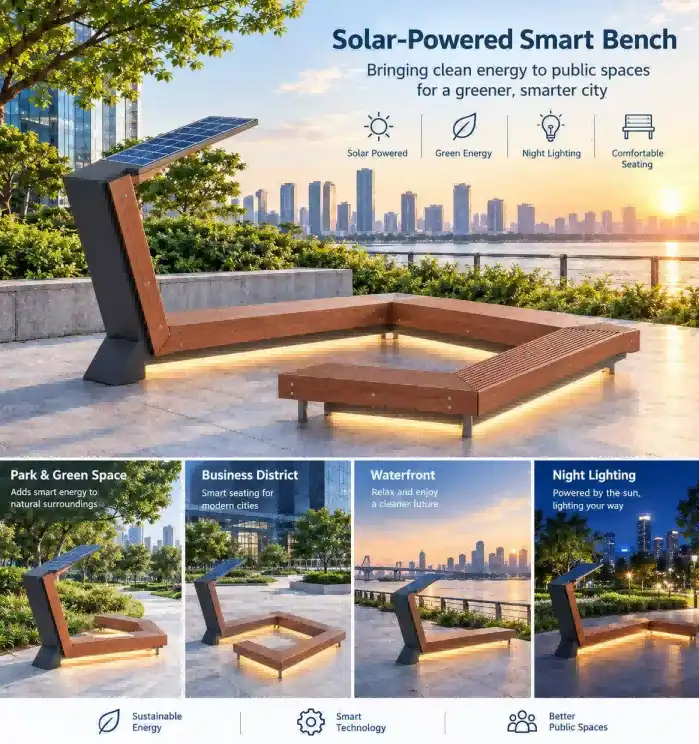
Future Trends and Innovation in Solar-Powered Landscape Seating
Emerging Photovoltaic Technologies
Thin-film and perovskite solar cell technology will be used in the next generation of solar furniture. This could make the panels 40–50% lighter and increase their efficiency to more than 25%. With flexible solar laminates, curved canopy designs will be possible that wouldn't be possible with rigid crystalline modules. This will open up more design options for buildings. In high-albedo areas like concrete plazas or light-colored paving materials, bifacial solar panels that collect light that bounces off the ground could increase energy production by 10 to 15 percent.
IoT Integration and Smart City Ecosystems
In the future, operations will focus on data-generating features in addition to basic functions. Environmental sensor kits will send real-time data about noise levels, temperature, and air quality to city screens. This will help with evidence-based urban planning. Occupancy sensors will give anonymous information about foot movement that will help with choosing store sites and making the most of public spaces. When smart city platforms are connected, dynamic feature control will be possible. For example, lighting levels can be changed based on the environment, and charging capacity can be prioritized during times of high demand. With these features, furniture that is normally inactive can become active infrastructure nodes in larger urban IoT networks.
Sustainability and Circular Economy Principles
More and more manufacturers are using circular design principles, which make it easier to reuse and recover old parts. When batteries run out of power or electronic parts become outdated, modular design lets you change just a few subsystems instead of the whole unit. 95% or more of aluminum and steel framing can be recycled. New take-back programs let companies get back used units, fix up functional parts, and sell them again on secondary markets. This extends the lifecycles of materials and lowers the amount of carbon that is used in new production.
Conclusion
Solar-powered outdoor seats are a mature, commercially viable option for businesses that want to be more environmentally friendly without losing functionality. Multiple procurement priorities are elegantly addressed by the design concept behind Smart seats with smart panels roofs, including the elimination of ongoing operational costs, the provision of quantifiable environmental benefits, the improvement of user experiences, and the encouragement of the development of smart city infrastructure. Technical progress keeps adding new features and lowering costs, which makes acceptance more appealing in a wider range of settings, from business campuses to public parks to transportation hubs. When purchasing these systems, procurement professionals should give more weight to providers that can show they can produce large quantities, make changes easily, and offer full support. This will ensure that the systems are used for a long time and work well, which is good for both the company and the community.
FAQ
1. Can solar-powered benches function reliably in regions with limited sunlight?
Modern energy storage systems can keep working even when it's cloudy for a long time. Most batteries are big enough to run a full system for three to five days without any sun power. In places that don't get much sunlight (like northern latitudes in the winter), hybrid setups can use grid backup charging or battery banks that are too big to make sure of service uptime. By analyzing the geographical spot during the planning phase of purchase, the right system size can be chosen based on the amount of solar radiation in the area.
2. What warranty coverage should procurement managers expect for these systems?
Manufacturers with a good reputation offer a range of warranties. Electronic parts like charge controllers and communication modules are covered for at least two years. Battery systems are covered for three to five years with guarantees that they will keep 80% of their capacity after 1,000 cycles, and solar panels and structural elements are covered for five to ten years. Full coverage should include technical support over the phone, access to replacement parts, and clear steps for taking service to the next level. Make sure that the warranty terms clearly cover exposure to the outdoors instead of controlled indoor conditions.
3. How do these systems reduce operational expenses compared to traditional powered furniture?
Solar benches get rid of the need for expensive electrical infrastructure installation ($3,500 to $8,000 per unit), ongoing utility costs ($180 to $420 per year), and electrical maintenance. A total cost of ownership study usually shows that the infrastructure pays for itself in four to six years, and after that, it only needs to be cleaned up once in a while and its batteries need to be replaced every five to seven years. When all installation, operation, and maintenance costs are added up over 15 years, solar solutions are often 40–55% cheaper than grid-powered alternatives.
Partner with Topview for Advanced Solar Seating Solutions
Topview's skills make it perfect for difficult commercial projects, making it the best choice for procurement managers looking for a reliable Smart seats with smart panels roof supplier. Our factory in Shenzhen has specialized solar furniture production lines that can make 100 units per day, as well as 13 years of experience working with LCD display technology. We keep a full list of certifications (CE, FCC, RoHS) and allow full OEM/ODM customization, which includes adding branded LED logos and changing the software interface, with no minimum order quantities for custom features. Our engineering team of more than 20 experts offers detailed documentation, help with installation, and quick support after the sale through their own channels. To talk about project details, get detailed sketches, or set up a sample evaluation, email our buying experts at market@tviewdisplay.com.
References
1. International Energy Agency Photovoltaic Power Systems Programme (IEA PVPS). (2023). Trends in Photovoltaic Applications 2023: Survey Report of Selected IEA PVPS Countries Between 1992 and 2022. IEA PVPS.
2. U.S. Environmental Protection Agency. (2022). Greenhouse Gas Equivalencies Calculator: Methodology and Technical Documentation. United States Environmental Protection Agency.
3. International Renewable Energy Agency (IRENA). (2023). Renewable Power Generation Costs in 2022. International Renewable Energy Agency.
4. International Electrotechnical Commission (IEC). (2021). IEC 61215: Terrestrial Photovoltaic Modules—Design Qualification and Type Approval. International Electrotechnical Commission.
5. International Energy Agency. (2022). Digitalisation and Energy: Smart Technologies for Sustainable Urban Infrastructure. International Energy Agency.
6. United Nations Human Settlements Programme (UN-Habitat). (2022). World Cities Report: Envisaging the Future of Cities. United Nations Human Settlements Programme.