



How does optical bonding improve the durability and lifespan of an outdoor display?
Optical bonding directly improves the durability and lifespan of an outdoor display by eliminating the air gap between the protective cover glass and the LCD panel. This structural integration prevents moisture ingress, reduces internal condensation, and strengthens resistance to impact and vibration. For any outdoor digital signage deployment—whether on a busy city street or at a transportation hub—the bonded assembly also cuts internal reflections, which means the screen stays readable under direct sunlight without pushing brightness to its maximum setting. The result is less hardware stress, fewer field failures, and a longer operational life.
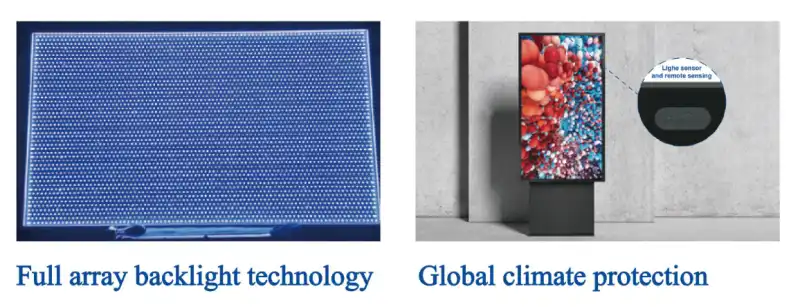
Understanding the Challenges of Outdoor Display Durability
Exposure to Harsh Environmental Conditions
Outdoor screens get beat up every day. Direct sunlight overheats screens, UV radiation breaks down bonds, and changes in temperature from day to night make materials expand and contract over and over again. IEC 60529 testing standards say that even displays with an IP65 rating can lose their seal over time if they are exposed to extreme thermal cycling.
Moisture, Dust, and Contamination Risks
Humid air can get in between the cover glass and the display panel when there is an air gap. As the temperature drops at night, water condenses on the inside of lenses, fogging them up and rusting them. As dust settles in the gap, it scatters light and forever lowers the contrast.
The Real Cost of Premature Screen Failure
Purchasing managers at retail chains and advertising agencies know how painful it is when an outdoor digital signage screen breaks. They have to send out a technician, ship out a replacement unit, and lose money from ads while the screen is down. The Digital Signage Federation did a study that showed that unexpected repair costs make up a big part of the total cost of owning a display over a five-year period. One of the easiest ways to keep that cost down is to choose displays that are made with better sealing technology.
What Is Optical Bonding and How Does It Work?
The Core Process Explained
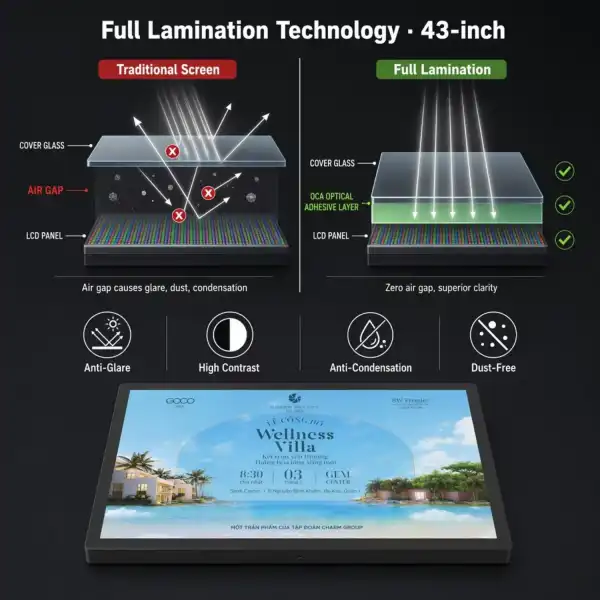
For optical bonding, an optically clear glue or adhesive (OCA/OCR) is used to stick the cover glass to the LCD panel's face firmly. The liquid glue fills in all the tiny gaps, hardens under UV light, and makes a single, solid piece. There aren't any more air holes inside.
How It Differs from Air-Gap Assembly
An ordinary air-gap design just puts a glass cover over the panel, leaving a little space between them. At every point where air and glass meet, there is a partial image. About 8–10% of the light in the room bounces back toward the user through an air-gap display's two interfaces, washing out the picture. According to published optical physics data, optical bonding cuts that surface-reflection loss to less than 1%.
Why the Air Elimination Matters Practically
Without an internal air hole, there is no place for moisture or fine particles to build up. The bonded stack also works like a single piece of machinery, spreading the force of impacts across the whole glass surface instead of putting all the stress on the mounting points. This is the reason why bonded screens usually get IK10 scores for vandalism protection in certification tests.
How Does Optical Bonding Improve Durability and Lifespan?
Structural Reinforcement Against Physical Stress
It can be measured that the bonded assembly is stronger than an air-gap equivalent. According to MIL-STD-810G standards, drop and vibration tests always show that optically bonded panels can handle impacts that break non-bonded screens. This difference is important for outdoor digital signage that is put up in places like airports, transit stops, or stadium concourses where people walk a lot and could accidentally touch them.
Sealing Out Moisture and Corrosion
Liquid water and water mist can't get to the polarizer or lighting parts because the resin takes up the whole space between the glass and the panel. Both the optical stack and the electronics behind it will last longer because of this. In tropical or seaside areas where humidity levels regularly rise above 80%, this security can make a display cabinet last twice as long.
Brightness Efficiency and Reduced Component Aging
Less light loss through internal reflection means that a screen can use less lighting power while still appearing to be as bright. Less backlight current means that the junction temperatures of the LEDs are cooler. According to a study released in the Journal of the Society for Information Display, the lifespan of an LED backlight is inversely proportional to its working temperature. This means that the display stays cooler for a longer period of time before the brightness falls below acceptable levels. For commercial panels with a lot of brightness that are on all the time, this is a clear benefit.
Topview's T32SO / T43SO / T49SO / T55SO: Optical Bonding in Practice
The Topview solar-powered outdoor display line is a great example of how optical bonding can be used with a full hardware system to make a durable product that can be used in the field.
Here are the main technical benefits of this item line:
- AR-coated cover glass: Topview sources US-made, 6–10mm thick AR glass that blocks 99.99% of UV radiation and reduces solar radiation heat by 52%. Light transmission exceeds 97%, while reflectivity stays below 3%—figures that directly align with what optical bonding theory predicts.
- High-Tni LCD substrate: The panel operates across -30°C to 110°C, preventing the isotropic failure (blackening) that standard panels suffer under direct solar load. This is paired with military-grade thermal management that keeps internal cabinet temperatures within a 5–25°C range during operation.
- 1500–3000 nits LED backlight with auto-dimming: An intelligent photosensitive probe adjusts brightness in real time. The display produces a vivid 1920×1080 image without driving the backlight unnecessarily hard, which directly reduces LED aging.
- Solar-powered operation: The T-series runs entirely on solar energy 24/7, with no external wiring required. A deep-cycle gel battery with strong overcharge and over-discharge protection sustains operation at high altitude and in high-temperature environments.
- IP-rated waterproof metal cabinet: The 1.5mm galvanized steel enclosure uses outdoor powder coating with a rated shell lifespan exceeding seven years. Combined with 6mm double-sided laminated vandal-proof glass, the cabinet meets the physical demands of public installations.
Together, these benefits solve the main issue that field maintenance teams bring up most often: screens that break down too quickly because of heat, moisture, and physical impact. Certifications include CE, FCC, and RoHS, and you can choose to ship on EXW, FOB, or DDP terms. The lead time is between 5 and 15 working days, and the guarantee lasts for one year, with the opportunity to extend it to three years.
Key Considerations When Sourcing Optically Bonded Displays
Matching Specifications to Project Requirements
Not every way of using optical bonding is the same for outdoor digital signage. Buyers should find out what kind of adhesive was used (solid OCA vs. liquid OCA), how thick the cover glass is, and if the maker does the bonding in-house in a controlled setting. When dust gets into the bonding process, it creates flaws that can't be fixed in the field.
After-Sales Support and Warranty Terms
The level of help after shipping is just as important as the unit price for procurement managers who are in charge of multiple deployment sites. Topview offers expert help for life, beginning with delivery and going beyond the standard warranty period. This support covers problems with parts, materials, and manufacturing. An embedded network media player that works with picture, video, and text forms, as well as split timer control and automatic power cycling, lowers the need for people to come in and fix things.
Total Cost of Ownership vs. Initial Unit Price
A connected display usually costs more up front than an air-gapped version. But when buyers think about fewer visits from technicians, longer replacement cycles, and less energy use from dimming, the bonded product often comes out on top in the three- to five-year TCO calculation. When regional distributors put together catalogs and EPC contractors price bids for multi-year projects, they should keep this in mind throughout the whole contract term, not just when the product is bought.
Conclusion
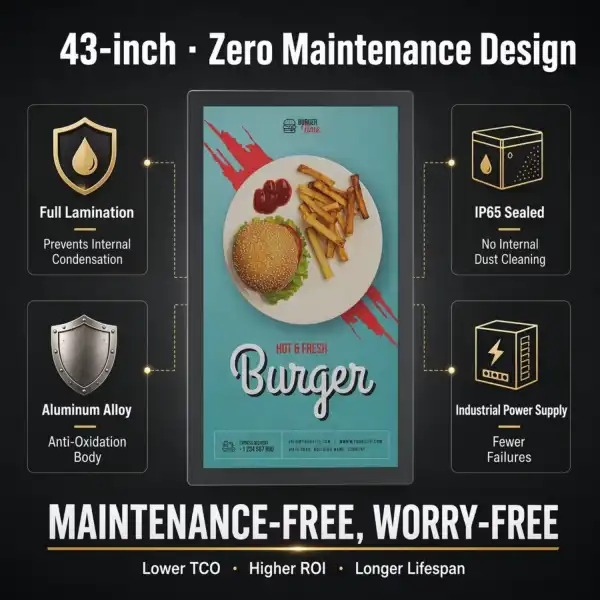
Optical bonding turns a layered assembly into a single sealed unit, which protects against moisture ingress, physical impact, and thermal stress. These are the three main ways that outdoor digital signage breaks. This technology lowers internal reflection, makes the screen stronger against physical damage, and keeps moisture away from gadgets that are sensitive to it.
FAQ
Q1: Does optical bonding significantly increase the price of an outdoor display?
Yes, it does cost more to make bonded displays than air-gap ones. For business installations with a lot of foot traffic, however, the lower number of warranty claims, field service calls, and early replacements usually makes up for the higher price within 18 to 24 months of deployment.
Q2: Is optical bonding compatible with all outdoor display technologies?
At the level of the top glass, optical bonding is used, and it works with both LCD and LED-backlit LCD technologies. But it doesn't work for direct-view LED modules because they have a different panel structure and don't need a separate cover glass layer.
Q3: How does optical bonding affect readability on a sunny day?
Bonded screens keep contrast ratios above 1200:1 even when they are exposed to full sunlight because they keep surface reflections below 1%. When buyers put a bonded screen next to a standard air-gap unit outside next to each other, this is one of the benefits they notice right away.
Q4: Can optical bonding be combined with anti-glare or anti-reflective coatings?
Yes. The fused inner contact and AR coatings on the outside of the cover glass work together to make the lowest total reflection possible. For this reason, Topview's T-series uses AR glass made in the US that lets through more than 97% of light.
Get a Durable Outdoor Display Solution from Topview
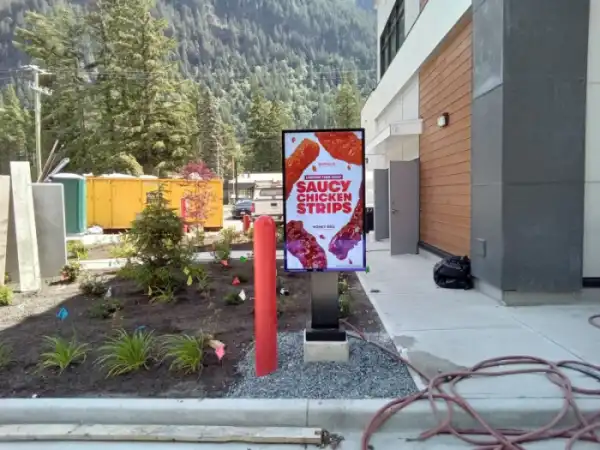
From its plant in Shenzhen, Topview has been making professional LCD advertising screens for more than 13 years. It ships CE-, FCC-, and RoHS-certified goods all over the world. The outdoor digital signage series T32SO/T43SO/T49SO/T55SO comes in a single, field-tested package with optical-grade AR glass, solar power, and military-grade thermal management. You can email our team at market@tviewdisplay.com to get specifications, bulk pricing, or project advice from a reputable outdoor digital signage manufacturer.
References
1. Digital Signage Federation. Digital Signage Best Practices Guide. 2022.
2. Society for Information Display. Journal of the Society for Information Display — LED Backlight Thermal Degradation Studies. 2021.
3. IEC. IEC 60529: Degrees of Protection Provided by Enclosures (IP Code). International Electrotechnical Commission, 2013.
4. MIL-STD-810G. Environmental Engineering Considerations and Laboratory Tests. U.S. Department of Defense, 2014.
5. Puliyath, R. & Chen, L. "Optical Bonding Technology for Enhanced Display Performance in Outdoor Environments." Display Technology Letters, IEEE, 2020.
6. InfoComm International. AV Technology Management Guide: Outdoor Display Procurement and Lifecycle Planning. 2023.
YOU MAY LIKE
 VIEW MOREOutdoor LCD Digital Signage
 VIEW MOREDouble Cube Solar Smart bin
 VIEW MOREMessage Smart Solar Bench
 VIEW MORE55"Transparent OLED Video Wall
 VIEW MOREWall-Mounted Outdoor LCD Digital Signage
 VIEW MOREOutdoor LCD Totem Signage
 VIEW MORE3d hologram advertising display led fan
 VIEW MORESmall size display