



What is a spatial display, and how does glasses-free 3D technology work?
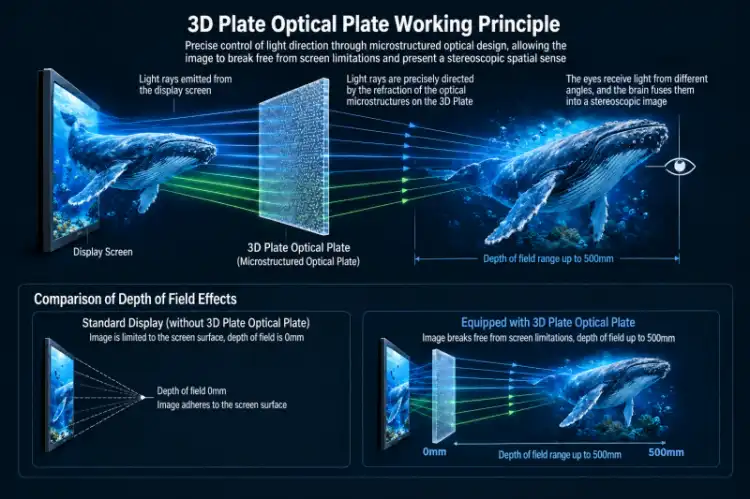
A spatial display is not a standard LCD screen. It is a glasses-free 3D advertising display engineered for commercial environments, and it sits at the center of what modern 3d spatial signage display technology can achieve. By projecting distinct images to the left and right eyes simultaneously, it uses binocular parallax to let the brain perceive depth naturally. No headsets, no polarized glasses, no special eyewear of any kind. The result is a realistic sense of three-dimensional space that viewers experience directly in front of the screen.
Understanding Spatial Displays and Glasses-Free 3D Technology
What Makes a Spatial Display Different
A normal screen shows the same flat picture to both eyes. A spatial display splits the visual output so that each eye sees the same scene from a slightly different angle. When those two signals are put together, the brain sees the difference as depth. This process is like how humans see, which is why the effect seems real and happens right away.
The Role of Binocular Parallax
What your left eye and right eye see may be slightly off from each other. This is called binocular parallax. It seems like there is more depth when there is more difference. Precision spatial screens can make this difference, giving you a depth-of-field area of up to 500 mm and a 3D viewing angle of 60 degrees.
The "2D Subject, 3D Background" Rendering Method
This screen has a certain way of showing things: the subject in the center is shown with a sharp 2K or 4K resolution, and the background has a depth effect. This method fixes two issues that older autostereoscopic screens had: images weren't as clear, and the sweet spots were too small. The result is a clear, well-defined subject that seems to float above a very full-of-space background.
Key Types and Technologies of 3D Spatial Signage Displays
Lenticular Lens and Parallax Barrier Approaches
The 3d spatial signage display, like most commercial glasses-free 3D screens, uses either a lenticular lens array or a parallax barrier. With lenticular lenses, light is bent at exact angles to reach each eye. Some pixels can't be seen by either eye because of a layer of slits in parallax barriers. Both ways produce autostereoscopic output without the need for glasses, but lenticular systems usually produce clearer output since they don't block light as strongly.
Light Field and Holographic Formats
Light field displays reconstruct all of a light source's directional information, which lets you see things from different angles at the same time. Holographic projection uses diffraction to make images that float in the air, but it needs controlled lighting and is harder to use on a large scale. When it comes to picture quality, brightness, and ease of installation, lenticular screens are the best choice for most business-to-business settings.
How This Compares to Standard LED Signage
Traditional LED screens are bright and have a wide viewing area, but the images they show are flat. A commercial 3D display that doesn't require glasses gives the impression of more depth without losing HDMI or Android/PC support. The spatial display works just as well as high-end commercial screens, but it looks very different. It has a contrast ratio of 1200:1, a viewing angle of 178°, and a possible brightness level of up to 1000 cd/m².
Benefits and Applications of 3D Spatial Signage Displays in B2B Sectors
In business-to-business (B2B) settings, glasses-free 3D screens have real, measured value. Nielsen research from 2022 found that digital ads with motion and depth get up to 47% more attention than ads that are flat. Those are the kinds of attention that procurement managers and brand directors want.
Here are the main areas where this technology clearly makes a difference:
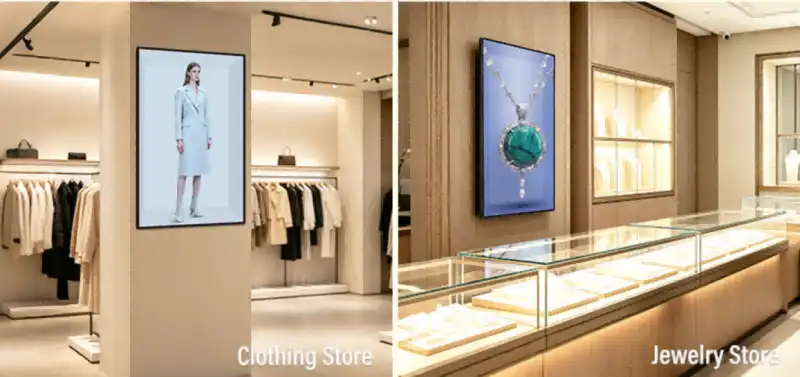
- Luxury Retail: Jewelry, watches, and handbags gain visual texture and dimensionality that flat screens cannot replicate. A spatial display lets customers see product detail and depth from a natural standing distance, encouraging longer dwell time.
- Museums and Exhibition Halls: Artifacts and specimens appear to float within the display frame, producing an interactive quality without any physical handling. This is particularly effective for cultural institutions managing fragile or rare objects.
- Shopping Malls and Airports: High-traffic environments benefit from displays that stop people mid-stride. With optional brightness at 1000 cd/m², the screen maintains visibility even in bright ambient conditions.
- Fashion Retail: Dynamic virtual models presented on a spatial screen extend customer engagement and reduce the need for physical mannequins or printed materials, lowering ongoing display costs.
The fact that these apps exist for the 3d spatial signage display shows that spatial 3D signage is not a new idea. It's a useful way to communicate that can lead to measured business results.
How to Choose the Right 3D Spatial Signage Display for Your Business?
Match Screen Size to Viewing Distance
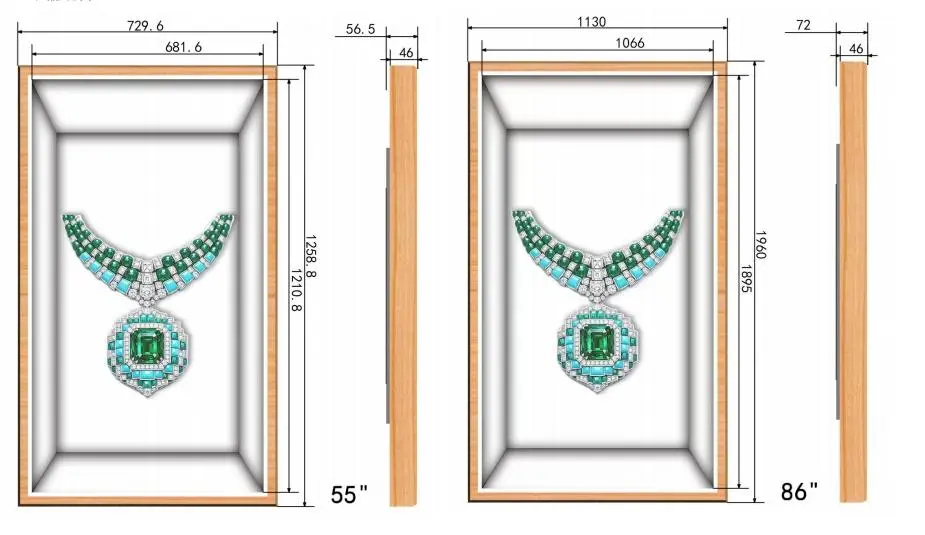
The best viewing range for the 3D depth effect depends on the size you choose. The sizes that are available—21.5", 32", 55", and 86"—fit different types of spaces. At a store counter or exhibition kiosk, a 32-inch unit works well, while an 86-inch unit is better for airport atriums or large showroom walls. The binocular parallax effect is kept when the screen is matched to the predicted viewing distance.
Evaluate Brightness and Anti-Glare Requirements
The light level is usually around 350 cd/m². The extra 1000 cd/m² setup gives enough contrast in places with bright overhead lighting or natural light. The extra anti-glare covering, which uses atomization technology to create diffuse reflection instead of specular reflection, makes places where people spend a lot of time, like museums or business stores, easier on the eyes.
Assess System Integration Needs
Early on, AV integrators and project managers should make sure that everything works together. The display comes with HDMI input and can be set up for either Android or PC. The 9:16 portrait aspect ratio and wall-mount installation (with optional floor-standing installation) make it easy for installers to use the unit in a variety of project plans without having to make any structural changes.
Procurement and Implementation Guide for 3D Spatial Displays
Working With a Manufacturer Directly
When you buy a 3d spatial signage display directly from the factory instead of a distributor, lead times are shorter, and you have more OEM/ODM choices. The housing can have custom branding put on it, such as logos that are silk-screened or backlit by LEDs. You can get power-on logos, unique color finishes, and software setups without having to buy a certain number of units first. This makes it easy for both large-scale rollouts and pilot projects.
Installation and Site Preparation
The display can work with normal US business power because it can accept AC 110–220V input. For wall-mounted installation, the surface must be flat, stable, and able to hold the weight of the unit. If the display is floor-standing, make sure that there is no foot traffic in the 60-degree 3D viewing cone. People walking through that area will change how stationary viewers see the 3D quality.
Maintenance and Long-Term Operation
LED backlighting with a standard 5% haze (or an optional 25% haze) keeps the brightness constant over the life of the panel. The reaction time of 8ms and the working frequency of 60Hz make it possible to play material smoothly without motion artifacts. For places that are open 24 hours a day, seven days a week, the extra higher-brightness configuration and anti-glare treatment make the screens last longer in tough circumstances.
Conclusion
The 3d spatial signage display is a useful way for B2B buyers to show off companies, goods, and information with real depth of field. The glasses-free method takes away any hassle for viewers and gets rid of the need for complicated headset systems. This group of displays comes in sizes ranging from 21.5" to 86", resolutions from 2K to 4K", and a variety of ways to connect to a system via HDMI, Android, or PC, making them suitable for a wide range of business uses. The technology gets people's attention and keeps them interested in a way that regular flat screens don't, whether it's in a high-end store, a museum exhibit, an airport advertising wall, or a trade show booth.
FAQ
Q1: What content format works best on a glasses-free 3D display?
The display uses a "2D subject, 3D background" rendering model. Content must be produced specifically for this format — standard videos do not automatically convert into 3D output. Most manufacturers, including Topview, provide content specifications or can refer clients to compatible content production partners.
Q2: Can the display run continuously in commercial environments?
Yes. The LED backlight and stable display board are designed for extended operating hours. For environments requiring 24/7 operation, the high-brightness configuration at 1000 cd/m² is recommended to maintain adequate luminance over time.
Q3: Is the display compatible with existing AV systems?
HDMI input is standard, with Android and PC system options available. This covers the majority of commercial AV setups used in malls, airports, and corporate environments.
Q4: What customization is available for OEM or branded deployments?
Logo customization (silk-screen or LED backlit), custom housing colors, power-on logo settings, and software modifications are all supported. There is no minimum order quantity requirement for custom projects.
Partner With Topview for Your Next 3D Spatial Signage Display Project
Topview has been making LCD advertising displays in Shenzhen for more than 13 years. They have a 2,000-square-meter factory with three production lines and a group of more than 10 engineers who work on research and development. Topview, a direct 3d spatial signage display manufacturer, offers OEM/ODM customization, competitive wholesale pricing, and custom orders with no minimum order quantity. The spatial display range comes in sizes of 21.5", 32", 55", and 86". It is ready to be used in shopping, leisure, transportation, and exhibitions. You can email the team at market@tviewdisplay.com to get a product specification sheet or talk about the needs of your project.
References
1. Nielsen Consumer Neuroscience. Attention and Engagement in Digital Advertising. Nielsen, 2022.
2. Holliman, N. S. 3D Display Systems. Institute of Physics Publishing, 2006.
3. Dodgson, N. A. "Autostereoscopic 3D Displays." IEEE Computer, 2005.
4. Urey, H., et al. "State of the Art in Stereoscopic and Autostereoscopic Displays." Proceedings of the IEEE, 2011.
5. Smolic, A., & Kauff, P. "Interactive 3-D Video Representation and Coding Technologies." Proceedings of the IEEE, 2005.
6. Digital Signage Federation. Digital Signage Best Practices Guide. Digital Signage Federation, 2021.