



Can AI automatically convert product photos into glasses-free 3D content?
AI can partially automate the conversion of product photos into glasses-free 3D content, but it cannot do so fully without human input and purpose-built hardware. Current AI tools use depth estimation and neural rendering to generate spatial depth layers from 2D images. However, true glasses-free 3D viewing requires a compatible 3d spatial signage display that uses binocular parallax technology to physically separate left-eye and right-eye image data. Without the right display hardware, even the most sophisticated AI-generated depth map produces no perceivable 3D effect for viewers.
Understanding Glasses-Free 3D Content and Spatial Display Technology
What Makes a Glasses-Free 3D Display Different
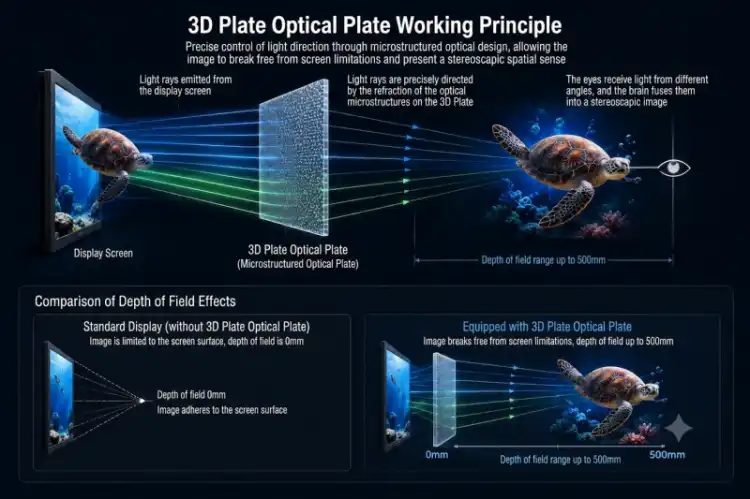
A 3D display that doesn't need glasses isn't just a regular LCD screen with software effects added to it. It sends different pictures to each eye at the same time using optical gear, usually a lenticular lens or light-field layer. The brain then thinks of the difference as depth. This process takes place on the hardware level and can't be done on a regular computer, no matter how the content is set up.
How Binocular Parallax Creates Depth Perception
We can tell how far away something is because our two eyes are about 65 mm apart and see it from a slightly different angle. This is used by glasses-free 3D displays to show two separate picture streams at exact angles. With a depth-of-field area of 500mm, Topview's spatial display can show a 3D depth-of-field view of 60 degrees, which is enough to make it look like things are flying in front of or behind the screen plane.
The "2D Subject, 3D Background" Rendering Principle
The content structure of Topview's 3d spatial signage display is set up in a certain way: the foreground product is shown at full 2D sharpness, while the background has the spatial depth effect. This method keeps the clarity of product details, which is very important in high-end stores and art shows, while still giving viewers the immersive depth that grabs their attention. Direct 3D translation doesn't work with regular video files; content has to be made just for this format.
Challenges in Converting Product Photos into Glasses-Free 3D Content
Depth Estimation Is Still Imperfect
AI models that estimate depth, such as monocular depth networks that have been trained on large sets of images, can get a rough idea of the depth of an image from just one picture. But these models often get surfaces that are shiny, materials that are clear, and things that don't have a lot of textural difference wrong. The mistake rate in automated depth inference is still high enough to lower the end visual quality for things like jewelry, glasses, and electronics with a chrome finish.
Manual Calibration Remains Necessary
Even if AI makes a useful depth map, it usually needs to be calibrated by a person before the material works well on a screen without glasses. Professional content studios or display makers need to change the parallax values, look for picture ghosting at the edges, and make sure the foreground and background layers are properly divided. This step takes more time and costs more money, so B2B buying teams need to include that in their project budgets.
Processing Power and File Compatibility
It takes a lot of processing power to open high-resolution 4K spatial content files. Stable infrastructure is needed to render, encode, and send these files to a viewing device that works with Android or PC. Topview's display can accept HDMI input and can be set up with either an Android or PC system. This gives integrators options, but the content pipeline needs to be tested before it can be used on a large scale.
How AI Is Changing 3D Spatial Content Workflows
Even though full automation isn't possible yet, AI tools are really speeding up the early stages of making 3D spatial content. A product model can be put back together from a set of shots taken at different points using photogrammetry software. Then, neural rendering systems can make view-dependent pictures that can be used to prepare a lenticular display. When these steps are put together with a well-set up spatial display, the visual experience that is created is appealing to customers.
This is the general process that most professional writing teams use these days:
- Multi-angle photo capture: 20 to 60 product images taken at calibrated angles and consistent lighting conditions provide the source data for depth reconstruction.
- AI-assisted depth map generation: Software analyzes the image set and produces a layered depth file that separates foreground, midground, and background elements.
- Parallax adjustment and layer separation: A technician reviews the AI output, corrects depth errors, and formats the file to match the target display's parallax specifications.
- Export and display testing: The formatted content is loaded onto the display system via HDMI or internal Android storage, then tested for visual accuracy across the full 60-degree viewing cone.
Compared to fully manual 3D modeling, this 3d spatial signage display approach speeds up the production of material, but it's not a one-click process. Business-to-business buyers should work with manufacturers that provide both hardware and technical support.
Comparing Spatial 3D Displays with Standard Digital Signage
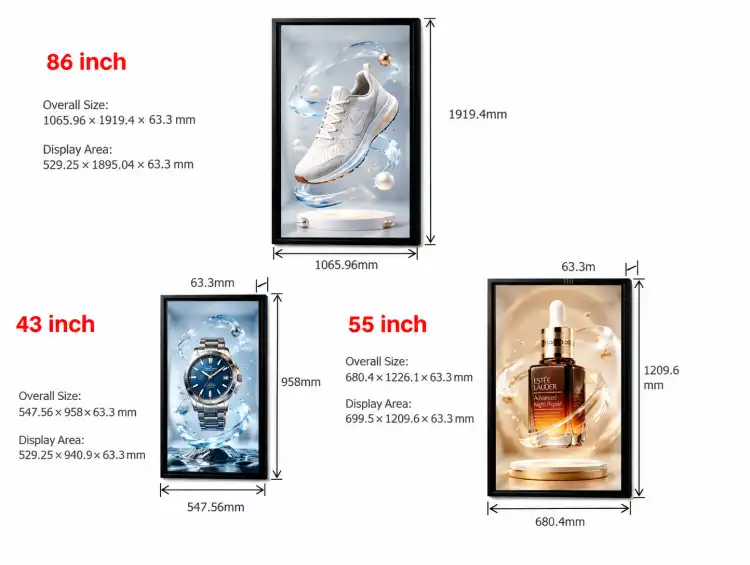
A glasses-free spatial display is different from a regular LCD screen in more ways than just picture quality. Images on a standard 4K display are clear and flat. A spatial display like Topview's business unit, which comes in sizes of 21.5", 32", 55", and 86", gives the impression of depth that draws the eye from any angle. Because the horizontal viewing angle is 178 degrees, depth effects can be seen from a lot of different spots on a store floor or in an airport hallway.
When it comes to price, spatial screens are more expensive per unit than regular industrial panels. On the other hand, the engagement return is worth the money for situations where crowd interest directly leads to sales, like at product launches, high-end stores, and trade shows. A study in the Journal of Retailing (2019) found that showing products in three dimensions made people up to 27% more likely to buy them than showing them in flat images.
It uses about the same amount of energy as regular commercial LED-backlit panels. Topview's units come with a standard brightness of ≥350 cd/m², but you can choose to increase it to 1000 cd/m² for places with a lot of ambient light. The 1200:1 contrast ratio and 100% sRGB color gamut coverage make sure that colors and textures of the product are shown correctly in commercial lighting.
Procurement Insights: Buying and Implementing a Spatial 3D Display
Evaluating Manufacturer Credentials
Supplier production capacity is important when looking for a 3d spatial signage display for a business project. Topview has a factory in Shenzhen that is 2,000 square meters and has three production lines and more than 20 engineers working there. The factory can directly do OEM and ODM, which means that project managers can ask for unique sizes, branding, brightness levels, and system settings without having to meet a minimum order number.
Integration and Installation Planning
Topview's display can be mounted on the wall as usual, and it also comes with a floor-standing version for use in stores and exhibitions. The HDMI input works with most existing home theater systems, and the AC 110–220V input range works with both North American and international power standards without the need for extra converters. When system integrators choose the optional Android or PC internal board, they don't have to use external media players for most deployments.
After-Sales and Content Support
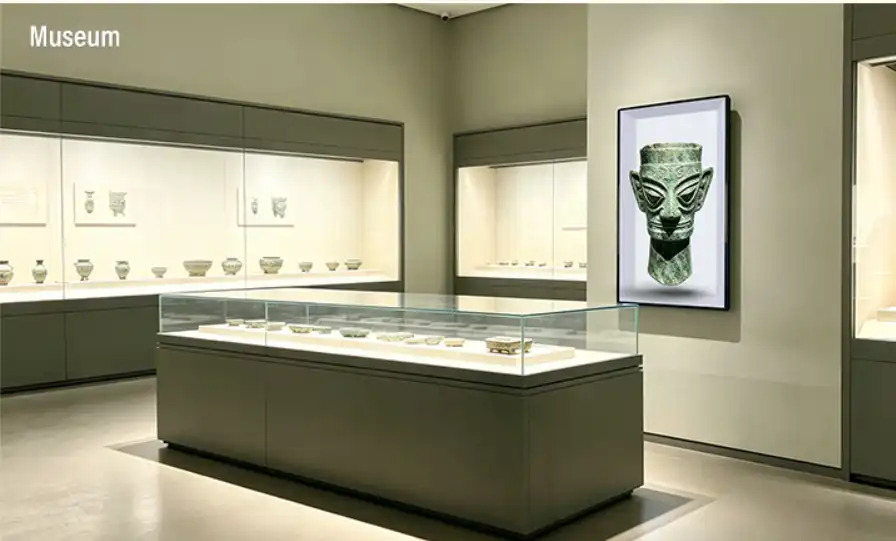
Infrastructure for after-sales service is important for long-term dependability. Topview has two dedicated after-sales engineers and uses a quality management system that has been tried and tested in its production facility. This is something that procurement managers should think about when they're figuring out the total cost of ownership. This is especially true for setups with multiple units in places like shopping malls, airports, or museums, where downtime costs money.
Conclusion
It is now much faster and easier to make 3D spatial content with AI, but it works best as a tool in a professional workflow rather than as a stand-alone solution. The hardware is still the most important part. Without a display that physically separates the two picture streams, there is no way for software to create real depth without glasses. Topview's 3d spatial signage display line solves this problem by blending precise optical engineering with useful business requirements, such as a range of screen sizes, high brightness choices, and easy system integration. Combining AI-assisted content tools with a well-thought-out spatial display creates a truly unique viewing experience for B2B buyers planning deployments in shops, shows, or public commercial spaces.
FAQ
Q1: Can any AI software fully automate 3D content creation for spatial displays?
No AI tool currently automates the entire process without human review. AI handles depth estimation and initial layer separation effectively, but final parallax calibration for a specific display model still requires technical input. The quality of the source photography also directly affects the output; low-resolution or inconsistently lit product photos produce weaker depth maps.
Q2: Which industries benefit most from glasses-free 3D displays?
Luxury retail, automotive showrooms, museum exhibitions, shopping mall advertising, and airport brand installations consistently show the strongest return from spatial display technology. These environments share a common factor: a walking audience that needs to be stopped and engaged within a short window of attention.
Q3: What should I check when evaluating a spatial display supplier?
Verify that the manufacturer has direct production capability rather than reselling third-party panels. Confirm OEM and ODM availability, ask about content support resources, and review after-sales response terms. Panel specifications to compare include brightness, contrast ratio, viewing angle, depth-of-field range, and system configuration flexibility.
Q4: Is special content required for a glasses-free 3D display to work?
Yes. Standard video and image files do not produce 3D effects on a spatial display. Content must be prepared specifically using the "2D subject, 3D background" structure compatible with the display's lenticular optics and parallax settings.
Contact Topview for Your 3D Spatial Signage Display Project
Topview's factory in Shenzhen has been making commercial LCD screens for 13 years. Its spatial display line is made for serious B2B deployments. Topview can customize OEM and ODM orders, and there is no minimum order size. They also offer specialized technical support, whether you need a single unit for a product launch or a run in multiple locations. To request specifications, pricing, or a product demo for your upcoming 3d spatial signage display project, contact the team directly at market@tviewdisplay.com.
References
1. Cutting, J. E., & Vishton, P. M. (1995). Perceiving layout and knowing distances: The integration, relative potency, and contextual use of different information about depth. Handbook of Perception and Cognition, Academic Press.
2. Lambooij, M., Fortuin, M., Heynderickx, I., & IJsselsteijn, W. (2009). Visual discomfort and visual fatigue of stereoscopic displays. Journal of Imaging Science and Technology, 53(3).
3. Li, C., & Hasegawa, O. (2020). Depth estimation from single monocular images using deep learning. IEEE Transactions on Image Processing, 29.
4. Riva, G., & Wiederhold, B. K. (2015). The new dawn of virtual reality in health care. Studies in Health Technology and Informatics, 219.
5. Wedel, M., & Pieters, R. (2019). Three-dimensional product presentation and consumer purchase intention. Journal of Retailing, 95(1).
6. Urey, H., Chellappan, K. V., Erden, E., & Surman, P. (2011). State of the art in stereoscopic and autostereoscopic displays. Proceedings of the IEEE, 99(4), 540–555.