



What applications are best suited for IP66 optically bonded digital signage?
IP66 optically bonded digital signage performs best in environments where weather exposure, direct sunlight, and physical contact are daily realities. The most suitable applications include outdoor advertising displays, transportation hubs, retail storefronts, stadiums, smart city infrastructure, and government information systems. These settings demand dust-tight, high-pressure water-resistant enclosures combined with optically bonded screens that eliminate internal condensation and maintain sharp visibility under bright conditions. For procurement managers sourcing outdoor digital signage solutions, understanding where this technology fits is the first step toward a sound investment.

Understanding IP66 Optically Bonded Digital Signage
It's helpful to know what makes IP66 optically bonded displays different from regular business screens before looking at uses.
What IP66 Certification Actually Means
IEC standard 60529 sets the rules for the IP (Ingress Protection) rating system. The first "6" in IP66 means that it is completely dust-tight, and the second "6" means that it can withstand strong water jets coming from any direction. Since IP66 enclosures are waterproof, they can be used outside in seaside towns, industrial areas, and places where it rains a lot—places where lower-rated displays would break in months.
How Optical Bonding Improves Display Performance
An perfectly clear adhesive resin is used to fill the space between the LCD screen and its protective cover glass during the making process. This gets rid of the air layer's internal reflections, which lower contrast when there is a lot of light around. This makes a screen that can be read in direct sunlight, has deeper colors, and doesn't get condensation on it. Bonded screens are also better at absorbing physical shocks, which makes them less likely to break or vibrate by mistake.
Key Technical Features That Matter in Practice
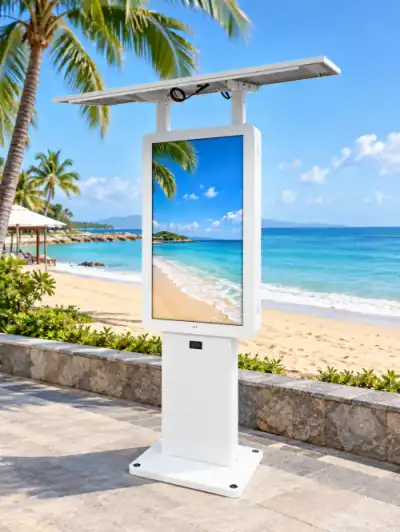
The Topview's outdoor digital signage T32SO, T43SO, T49SO, and T55SO series are based on these ideas. They have an LED-backlit LCD screen with 1500–2000 nits of brightness, can work in temperatures ranging from -30°C to 110°C, and have AR glass from the US that stops 99.99% of UV rays while letting more than 97% of light through. The units are certified by FCC, RoHS, and CE, run on solar power, and don't need to be wired in. They ship in reinforced wooden cases and take 5–15 working days to arrive.

Top Applications Ideal for IP66 Optically Bonded Digital Signage
For a long time, IP66 optically bound screens have been used in many public and business places. Here are the industries where they clearly make the most money and improve operations.
Outdoor Retail and Shopping Mall Environments
Retailers who are in charge of stores, mall entrances, or drive-thru menu boards need displays that can withstand weather, temperature changes, and direct sunlight without any help from staff. IP66 optically attached screens keep the quality of the images the same all year long. Their 1920x1080 quality and auto-brightness feature make promotional material clear and noticeable whether it's cloudy or bright outside. These displays protect the brand image at places of contact with customers and cut down on repair calls for procurement managers at retail chains or commercial property developers.
Transportation Hubs and Smart City Infrastructure
Airports, metro stations, and bus stops are places with a lot of people and a lot of humidity. In these places, screens have to deal with steam, cleaning sprays, spilled liquids, and temperature changes between indoor and outdoor areas. Enclosures with an IP66 rating can handle all of these conditions without breaking down. Topview's solar series has an embedded network information release system that lets you send real-time schedule updates, video content, and text broadcasts over cable or offline media. This makes it useful for transit authorities and smart city project managers who need public display infrastructure that is reliable and doesn't need much upkeep.
Stadiums, Events, and Outdoor Advertising
Large-scale event venues and people who run outdoor ads both have to deal with the same problem: content has to be able to be seen from far away in full sun, and equipment has to be able to handle the weather between events. These screens are strong because they have a brightness of 2000 nits, 6 mm double-sided laminated glass that can't be broken, and a housing that can work in full sunlight without the LCD getting dark. They are a good choice for EPC contractors taking on stadium or city advertising infrastructure projects because they have a galvanized steel cabinet that is rated for 7 years and a clever cooling system that keeps the temperature inside between 5°C and 25°C.
Comparing IP66 Optically Bonded Digital Signage to Other Outdoor Solutions
Honest comparisons are needed to make choices about purchases. This is how IP66 optically bonded displays compare to the other options.
IP66 Optically Bonded vs. Standard Outdoor Displays
Standard outdoor digital signage usually have an IP54 or IP65 grade. IP54 lets some dust in and some low-pressure water splash through, which is fine for covered installations but not enough for open-sky deployments. IP65 can block dust and low-pressure jets, but it can't stop high-pressure sprays going straight at it. IP66 fills in that blank. When paired with optical bonding, the display also doesn't fog up or condense inside like regular screens do over time, which is a major reason why they break down early in wet places.
IP66 Optically Bonded vs. Traditional Static Billboards
Static signs need to have their printed materials replaced physically, can't be moved around, and cost a lot to print every month. IP66 digital displays get rid of the need for printing altogether, let operators run multiple campaigns at set times, and support remote content management. The switch to digital signage has measurable cost savings and crowd targeting features that static forms just can't match for advertising media groups that run big billboard networks.
LED vs. LCD with Optical Bonding for Outdoor Use
LED modules have a higher peak brightness and work best for installations that are bigger than 10 meters away. However, LCD panels with optical bonding have sharper pixel density at closer viewing distances, which makes them useful for places like transit information boards, store windows, and kiosks. Topview's T-series LCD screens have a resolution of 1920x1080 and a brightness of 1500 to 2000 nits, which is bright enough for most street-level outdoor uses where readability at 2 to 8 meters is important.
Procurement Considerations for IP66 Optically Bonded Digital Signage
Cost vs. Performance for Bulk Orders
Displays that are optically bonded to IP66 standards cost more per unit than regular commercial screens. The total cost of ownership is much lower for large deployments, though, because they last longer, need less maintenance, and are replaced less often. Topview provides EXW, FOB, and DDP price terms with TT payment, which allows for creative purchasing arrangements for large sales in markets around the world.
Supplier Evaluation Criteria
A good supplier should have controlled manufacturing conditions, proof of quality tests, and expert help after the shipment. Topview has a clean workshop that is 2,000 square meters in size and has three production lines, more than 20 engineers, and a dedicated R&D team with an average of eight years or more of experience in the field. The factory has CE, FCC, and RoHS certifications, which help it meet international standards for government and EPC projects.
Installation, Maintenance, and Software Management
The stability of IP66 for outdoor digital signage depends on how it is installed. The wire entry places, mounting frames, and sealing seals must all be handled correctly. Topview gives full technical paperwork and permanent technical help from the time of delivery until the product is no longer under warranty. The built-in play system can handle pictures, videos, and text over the network or offline. It also comes with server management software that lets you set up schedules and keep an eye on things from afar.
Future Trends in Outdoor Optically Bonded Digital Signage
Solar-Powered and Off-Grid Display Solutions
Costs of energy and the difficulty of installing displays are pulling procurement teams toward solar-powered choices. Topview's T-series runs entirely on solar power and has deep-cycle gel batteries that work well at high altitudes and temperatures. There is no need for electricity lines, which lowers the cost of installation and lets it be used in places that don't have access to the grid.
IoT Integration and Smart City Connectivity
In the future, public displays will be linked to larger smart city sensor networks. This will allow material to be changed based on information about foot traffic, the weather, or emergency broadcast signals. Today, these integrations are made possible by Topview's embedded network player and industrial control computer option.
Advances in Thermal Management
As the need for monitor light rises, so does the production of heat. Topview's military-grade heat dissipation system and intelligent temperature-controlled airflow keep panel temperatures within safe operating ranges even when they are exposed to direct sunlight for a long time. This is an engineering requirement that will become more important as the number of displays increases.
Conclusion
When outdoor digital signage needs to work outside in all kinds of weather, be readable in daylight, and last a long time, IP66 optically bonded signs are the best option. These displays regularly beat lower-rated options when it comes to sturdiness and total cost of ownership. They can be found in retail stores, transit hubs, arenas, and government information systems. The Topview's T-series is a solar-powered, high-brightness display that meets the technical and business needs of procurement managers, AV installers, distributors, and EPC contractors who want to buy proven outdoor digital signage solutions directly from the maker.
FAQ
Q1: How does optical bonding specifically improve outdoor readability?
The air gap between the LCD screen and top glass is closed off by optical bonding. This gets rid of internal light reflections that make the picture look dull when it's bright outside. Because of this, the contrast ratio stays above 1200:1, even in bright sunlight, so people walking by can easily read the text without using more power.
Q2: What is the difference between IP65 and IP66 for outdoor signage?
Both scores show that there is no dust at all. The difference is how well it resists water. IP65 protects against water jets with low pressure, and IP66 protects against water jets with high pressure coming from any direction. IP66 is the base standard that should be used for open-sky sites that will be hit by strong rain, pressure washing, or coastal spray.
Q3: Can IP66 optically bonded displays operate in extreme temperatures?
Yes. The Topview's T-series has an LCD substrate that can handle temperatures from -30°C to 110°C and an intelligent cooling system that keeps the internal temperature between 5°C and 25°C. The panel is designed to stop isotropic failure, which is the black-spot problem that happens on regular LCD screens when they are exposed to direct sunlight.
Q4: What warranty and support does Topview provide?
All Topview outdoor screens come with a one-year guarantee, but you can get an extra three years if you want to. Lifetime technical support is included from the time of delivery and covers both defects that are still under warranty and operational questions that have been answered after the warranty period.
Partner with Topview for Your Next Outdoor Digital Signage Project
Topview is a factory-direct outdoor digital signage maker based in Shenzhen. They have been making signs for more than 13 years and have CE, FCC, and RoHS approvals. The T32SO, T43SO, T49SO, and T55SO series can be shipped in 5–15 business days, and prices can be set for EXW, FOB, or DDP. We accept OEM and ODM orders, and there is no minimum number needed. To get a price or product detail sheet, email our team at market@tviewdisplay.com.
References
1. International Electrotechnical Commission. IEC 60529: Degrees of Protection Provided by Enclosures (IP Code). IEC, 2013.
2. Grand View Research. Digital Signage Market Size, Share & Trends Analysis Report. Grand View Research, 2023.
3. InfoComm International. AV Technology Standards for Outdoor Display Systems. AVIXA, 2022.
4. MarketsandMarkets. Outdoor Digital Signage Market — Global Forecast to 2028. MarketsandMarkets, 2023.
5. Society for Information Display. Advances in High-Brightness LCD Technology for Outdoor Applications. SID Symposium Digest, 2021.
6. Digital Signage Federation. Best Practices for Outdoor Digital Signage Deployment and Maintenance. DSF Industry Report, 2022.