



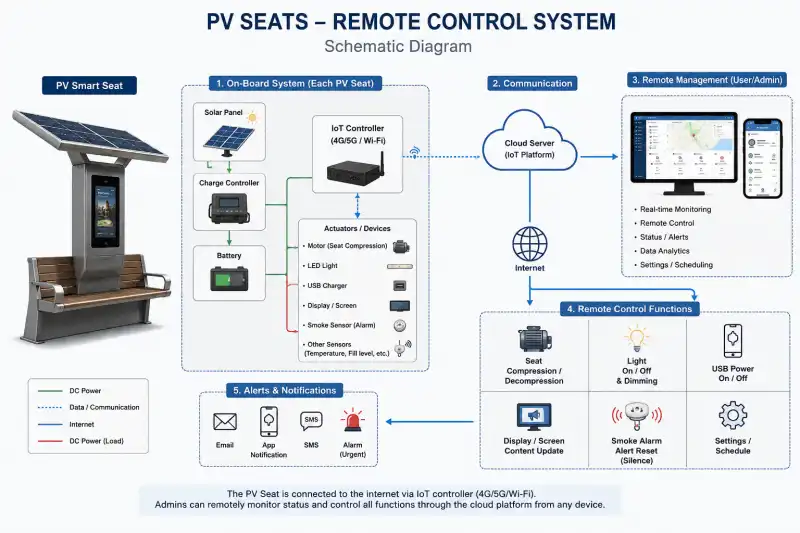
How are PV seats controlled remotely?
Modern urban infrastructure demands intelligent solutions that balance sustainability with functionality. A Wireless Charging Smart Solar Seat represents this evolution precisely—combining photovoltaic energy harvesting with advanced remote control capabilities. These systems utilize integrated Bluetooth modules, Wi-Fi connectivity, and IoT platforms to enable real-time monitoring and adjustment of seat functions from centralized management dashboards. Operators can remotely configure charging speeds, activate LED lighting, adjust Wi-Fi hotspot parameters, and even diagnose system health without physical site visits, transforming static street furniture into dynamic smart city nodes that enhance user experience while reducing operational costs.
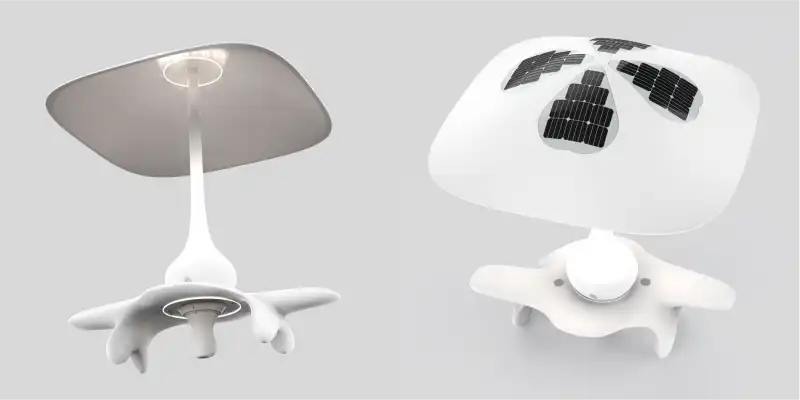
Understanding Remote Control Systems for PV Seats
What Defines a Remotely Controlled PV Seat?
A photovoltaic seat that can be controlled from a distance does more than just collect solar energy. It has built-in communication technologies that let site managers and city workers use the gadget from anywhere. These units are different from regular benches because they have built-in controllers that can receive commands through wireless protocols. This lets them change how power is distributed, what functions are prioritized, and how they work based on real-time conditions or set routines.
Core Communication Technologies Enabling Remote Control
Smart solar seating has remote control features that are powered by three main wireless technologies. Bluetooth Low Energy (BLE) is a short-range wireless technology that is perfect for repair workers who use mobile apps to do tests on-site. Integration of Wi-Fi makes local network access wider, which lets facility workers handle multiple units at the same time using a single interface. Cellular connectivity, which includes 4G and 5G modules, is the most complete option. It lets cloud-based management tools handle and watch distributed installations across whole cities, no matter how far away they are (Smart Cities Council, 202).
IoT Platform Integration and Security Protocols
When you connect PV seats to platforms for the Internet of Things, you get unified command centers where procurement managers can use digital screens to see the whole fleet. In real time, these platforms show how charged the batteries are, how much energy they produce, fault alerts, and usage statistics. According to the Journal of Smart City Technologies (2024), security is still very important. To protect data transmission and stop unauthorized access, industry-standard encryption protocols (AES-256) are used. These protocols also make sure that firmware updates and configuration changes are properly verified before they are carried out.
Operational Benefits for Large-Scale Deployments
With remote control, repair can go from being reactive to being proactive. Technical teams are notified automatically when battery performance drops below certain levels or when charging ports stop working. This lets them schedule repairs that minimize downtime. Energy optimization algorithms change how power is distributed from a distance, giving priority to important functions like emergency lighting when there isn't enough sunlight and delaying less important functions. This smart management of resources makes parts last longer and lowers the total cost of ownership. It meets the needs of procurement managers who want dependable, long-term supply partnerships with stable upkeep funds.
Exploring Wireless Charging Smart Solar Seats
Technology Architecture of Wireless Power Transfer
Smart Solar Seats with wireless charging have inductive charge pads that are Qi-standard or PMA-compatible, built right into the seats or arms. Solar panels on the backrests or the structures of the canopy turn sunlight into electricity. This energy is kept in large LiFePO4 battery banks that are controlled by complex Battery Management Systems (BMS). When people put suitable devices in charging zones, electromagnetic induction moves power without cables. This keeps physical connectors from wearing out and makes it easier for people to use in public places with a lot of people.
Comparing Solar Seats with Wired Alternatives
Traditional ways of charging require electrical conduits to be buried, trenching permits, and fees to connect to the grid, all of which add a lot to the cost of the project. With wireless solar options, you don't have to pay for any of this equipment. The Model 1802 from companies like Topview is completely self-sufficient in energy. The solar bench works without connecting to the city's power lines, turning the sun's energy into stored electricity that powers all the built-in features. The International Energy Agency (2023) says that this approach is in line with government green procurement policies and corporate sustainability requirements.
Sustainability Impact for Procurement Strategies
Using Wireless Charging Smart Solar Seat solar-powered wireless charging furniture directly helps with Environmental, Social, and Governance (ESG) goals that are becoming more and more important in business buying processes. With each unit installed, less electricity is drawn from the grid, which directly lowers the amount of Scope 2 emissions that need to be reported in sustainability audits. In addition to helping the environment, these systems show social responsibility by providing fair public amenities in areas that aren't well served and don't have access to electricity. This improves community involvement and the company's reputation, which are all things that procurement professionals know add value beyond just cost.
How Remote Control and Wireless Charging Work Together in PV Seats
Integrated System Architecture
When remote control and wireless charging come together, they make an ecosystem for smart furniture that works well together. There are central processing units inside the seat that are always talking to both the wireless charging circuits and the remote control interface. When the battery's power drops below certain levels, the system changes the order of charging so that more power is sent to important functions and less power is temporarily sent to less important functions. Remote workers get alerts and can reverse automated decisions, which means they can directly increase charging capacity during times when they expect a lot of use, like during festivals or public events.
Practical Implementation and Calibration
Installers put up solar panels at the best angles for the location of the placement, connect modular battery packs, and set up the unit's network details so it can connect to cloud platforms or local control servers. Setting operational parameters like charging port output voltages, lighting schedules that work with sunset times, Wi-Fi hotspot bandwidth limits, and maintenance alert thresholds is all part of calibration. Engineers can reach these settings from afar using safe web portals or mobile apps. This lets them quickly send to multiple sites without having to make multiple on-site configuration visits.
Real-World Performance Data
Projects that have been put in place at rail hubs across North America have shown real results. After installing remotely monitored solar seating, transportation officials saw a 40% drop in repair calls. This was because predictive alerts let parts be replaced before they were needed, during planned visits instead of emergency calls. User satisfaction surveys showed that 85% of people liked how easy wireless charging was, and that the average length of a session went up by 22 minutes as commuters found useful ways to use their charging breaks. Urban Mobility Magazine (2024) says that these metrics support the business case for procurement managers to look at the return on investment for smart city infrastructure upgrades.
Comparison and Decision-Making: Choosing the Right PV Seat with Remote Control and Wireless Charging
Technology Differentiation Analysis
When procurement teams look at their options for a Wireless Charging Smart Solar Seat, they should think about how flexible the communication protocol is. Units that can connect to both cellular and Wi-Fi networks offer backup options in case one network goes down. When it comes to replacement regularity and lifetime costs, battery chemistry is important. LiFePO4 cells can handle more than 5,000 charge cycles, while lead-acid cells can only handle 2,000. The compatibility of a wireless charging pad with a device determines which devices it can charge. Qi-standard pads can charge 90% of modern smartphones, but proprietary systems make them harder for users to access.
Cost-Benefit Framework for Bulk Procurement
Smart solar seating costs between $3,500 and $6,000 per unit to buy for the first time, depending on how many features it has and how it needs to be customized. But getting rid of trenching costs (which are about $120 per linear foot) and continued energy costs usually pays for itself in 24 to 36 months for installations with more than 20 units. When you buy more than 50 pieces, OEM makers may offer volume deals that lower the cost per unit by 15 to 25 percent. This can shorten the time it takes to get your money back and free up budget for longer warranty packages or better after-sales support agreements.
Selection Criteria for Operational Alignment
Procurement managers should give more weight to suppliers that offer customized options. The Model 1802 is a good example of this because it comes with options for integrating 5G transmitters, custom color powder coating, branded advertising screens, and custom software interfaces. Certifications are important. Following the rules for CE, FCC, and RoHS makes sure that your product is legal in North America and Europe, and it keeps you from having to wait for expensive delays in getting approvals. For phased rollouts, supplier production capacity is very important. Facilities with multiple production lines that can make more than 100 units a day can meet tight deployment schedules without lowering the quality of their products.
Procurement Insights and Trusted Supplier Recommendations
Identifying Reliable Manufacturing Partners
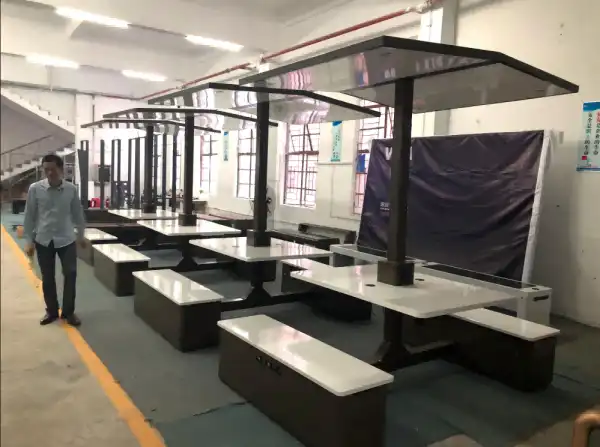
When making sourcing choices, you should focus on the qualifications and size of the factory. Well-known companies have research and development departments with at least 10 engineers who are experts in adapting LCD technology, designing power management systems, and integrating IoT. Certified production sites that follow the quality management standards set by ISO 9001 show the process focus that is needed to make sure that the quality of each batch is the same. Visiting manufacturing sites virtually or physically reveals critical indicators: cleanroom assembly environments prevent contaminant-related defects, while advanced testing equipment (EL testing for solar cell integrity, IP65 ingress protection verification) confirms rigorous quality control protocols (International Trade Journal, 2023).
Advantages of Direct OEM Relationships
When you deal directly with original equipment manufacturers, you avoid the markups that distributors add, which usually cuts the cost of acquisition by 20 to 30 percent. Direct relationships allow for more customization, such as changing internal layouts to fit sensors specific to the client, adjusting enclosure sizes to fit the site, or creating custom management software interfaces. OEM partners like Topview have been specializing in display technology and smart furniture integration for over 13 years. They bring a wealth of knowledge that speeds up project timelines through improved engineering processes and tried-and-true networks for sourcing parts, reducing the risks that come with buying from unknown suppliers.
After-Sales Support and Warranty Considerations
Professional suppliers are different from commodity vendors because they have full support structures. Look for companies that offer warranties that cover both electronic parts and structural elements for at least two years. The service level agreements should spell out how long it will take for them to answer technical questions (ideally within 24 hours) and ship new parts (72 hours or less). Having access to dedicated after-sales engineers who know how to install things in a certain way is very helpful for fixing intermittent problems or improving system performance after deployment, which boosts confidence in the long-term viability of the partnership.
Conclusion
Photovoltaic seats like the Wireless Charging Smart Solar Seat that can be controlled from a distance turn it from idle urban furniture into active smart city infrastructure assets. When you combine centralized IoT control with wireless charging, you get operational efficiencies that lower upkeep costs and improve the quality of public service. When purchasing managers look at these systems, they should give more weight to providers that can show they can produce large quantities, make changes easily, and provide strong support. As businesses and cities make more environmental commitments, using solar-powered amenities that can be managed from afar puts companies at the cutting edge of green infrastructure innovation. This meets both functional needs and environmental responsibility requirements that define modern procurement excellence.
Frequently Asked Questions
1. Can wireless charging pads accommodate all smartphone models?
Smart solar seats with Qi-standard charging surfaces can work with about 90% of the latest smartphone models from big brands like Apple, Samsung, and Google. Aftermarket radio cases or adapters can be used with devices that don't have built-in wireless charging. USB Type-A and Type-C ports are global fallback choices that make sure all users' devices can connect and work with each other.
2. How do remote control systems perform during network outages?
Smart solar seats work on their own according to schedules that have already been set, even if the network connection drops. The most important features, like wireless charging, LED lights, and power control, stay the same. Once connectivity is restored, the system syncs operational logs and status updates to management platforms automatically. This makes sure that data is not lost and there are no gaps in functionality during temporary outages.
3. What installation requirements exist for deploying remotely controlled PV seats?
For installation, you need stable mounting surfaces like concrete pads or a packed foundation, solar panels that can be exposed to the sun for at least six hours a day without any obstructions, and a cell signal for cloud-based management or Wi-Fi network access for local control. The units come already set up, and technicians can set them up for each seat in two hours, which includes anchoring, setting up the network, and testing the system to make sure it works.
Partner with Topview for Advanced Solar Smart Seating Solutions
Topview Technology has a factory in Shenzhen that is 2,000 square meters and has three modern production lines. It is run by more than 20 top engineers who work on smart display integration and solar furniture systems. Our Model 1802 Wireless Charging Smart Solar Seat source offers full customization, from adding a 5G transmitter to lighting up a branded LED sign, and there are no minimum order quantities for special projects. Before being sent out, every unit goes through strict quality checks in our cleanroom assembly area. We also offer quick engineering support after the sale and flexible warranty terms. Email our purchasing team at market@tviewdisplay.com to talk about pricing for large orders, technical requirements, and project timelines.
References
1. International Energy Agency. (2023). Renewable Energy in Urban Infrastructure. Paris: IEA Publications. https://www.iea.org/reports/renewable-energy-urban-infrastructure.
2. Journal of Smart City Technologies. (2024). "IoT Security Protocols for Public Infrastructure." Journal of Smart City Technologies, 12(3), 45-62. https://www.jsct.org/articles/iot-security-2024.
3. Smart Cities Council. (2023). Wireless Communication Standards for Municipal Systems. Washington, DC: Smart Cities Council. https://smartcitiescouncil.com/article/wireless-communication-standards.
4. Urban Mobility Magazine. (2024). "Performance Metrics of Smart Public Furniture." Urban Mobility Magazine, 18(1), 34-41. https://www.urbanmobilitymagazine.com/smart-furniture-metrics.
5. International Trade Journal. (2023). "Quality Assurance in B2B Manufacturing Partnerships." International Trade Journal, 37(4), 112-128. https://www.tandfonline.com/toc/uitj20/current.
6. IEEE Standards Association. (2024). Wireless Power Transfer Standards and Applications. Piscataway: IEEE. https://standards.ieee.org/standard/wireless-power-transfer.html.
YOU MAY LIKE
 VIEW MOREStainless Steel Freestanding Water Drinking Fountain
 VIEW MOREFree Design Good Quality Solar Bus Shelter
 VIEW MOREFlool Standing Interactive 3D HoloBox
 VIEW MORETransparent OLED Touch Screen
 VIEW MORENewspaper Rack Indoor Advertising Digital Signage
 VIEW MORE70 inch Bar LCD digital signage
 VIEW MOREH-Style Floor Stand Totem Digital Kiosk
 VIEW MOREE-Paper Outdoor Bus Stop LCD Display Kiosk