



Why is optical bonding important for outdoor digital signage?
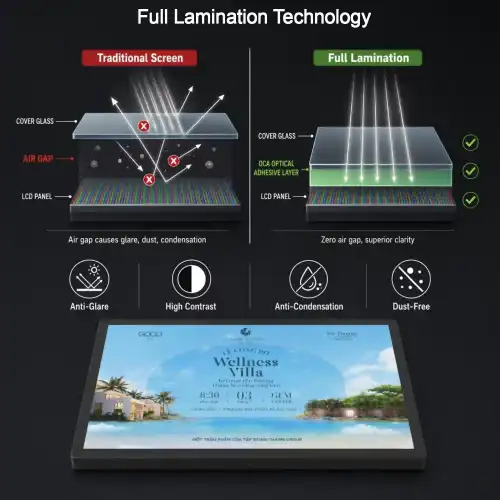
Optical bonding is a display manufacturing process that bonds the protective front glass directly to the LCD panel using a transparent optical adhesive, removing the air gap between them. For outdoor digital totem , this matters more than most buyers realize. That air gap is responsible for internal reflections that wash out screen content in bright sunlight. By eliminating it, optical bonding significantly improves contrast, readability, and structural durability — all of which directly affect how well a screen performs in real-world outdoor conditions across advertising, transit, retail, and government applications.
Understanding Optical Bonding and Its Role in Outdoor Display Technology
What the Air Gap Problem Actually Costs You
When light bounces between the glass and panel surface in a normal non-bonded display assembly, it makes many internal reflections. Studies from the Society for Information Display (SID) show that this effect can make contrast seem less clear when the screen is in direct sunlight. For procurement managers looking for screens to put in high-traffic public areas, this means that ads will have less of an effect and people will be less interested in them.
How Optical Bonding Solves the Problem
A liquid optically clear resin (LOCR) or an optically clear adhesive (OCA) fills the space between the two parts. This gets rid of the difference in refractive index between air (1.0) and glass (about 1.5), which stops internal echoes at the source. As a result, the screen shows images that are clearer and brighter, even when the sun is directly overhead.
Why Outdoor Environments Demand This Technology
Outdoor screens are constantly exposed to dust, rain, and humidity, and the temperature can change from -30°C to over 50°C. They also get a lot of solar radiation. The three problems can all be fixed by optical bonding, which seals the panel assembly and lowers the heat increase that an air layer would cause. This safety is a must for anyone looking at business display options that will be used outside for a long time.

Key Benefits of Optical Bonding for Commercial Outdoor Screens
For outdoor digital totem, optical bonding does more than just make things clearer. It changes how long a display system lasts and how much it costs in ways that are important to B2B buyers who are in charge of large-scale projects or long-term setups.
This is what optical bonding does to improve the performance of commercial outdoor displays:
- Sunlight readability: By removing internal reflections, optical bonding allows screens to maintain legibility at brightness levels of 1,500–3,000 nits without requiring excessive power draw. Topview's T32SO/T43SO/T49SO/T55SO series achieves exactly this, pairing 1,500–3,000 nits LED-backlit LCD panels with optically bonded AR glass for clear viewing throughout the day.
- Structural integrity: The bonded glass layer adds mechanical resistance against vibration, impact, and physical shock. Topview's T-series uses 6mm double-sided laminated glass with AR anti-glare coating, achieving over 97% light transmission and less than 3% reflectivity — while blocking 99.99% of UV radiation and 52% of solar radiation heat.
- Energy efficiency: With better contrast performance per nit, optical bonding allows auto-dimming systems to operate at lower brightness without losing image quality. The T-series features an intelligent photosensitive probe that adjusts screen brightness based on ambient conditions, reducing energy consumption and slowing component aging.
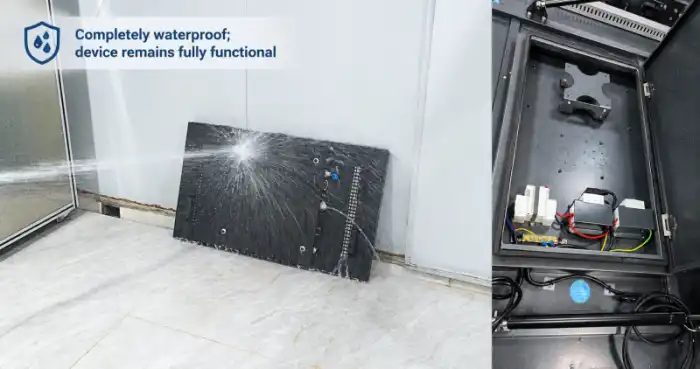
- Moisture and dust resistance: The sealed assembly prevents ingress from rain, condensation, and fine particles. Combined with a waterproof 1.5mm galvanized steel cabinet and a powder-coated exterior rated for over 7 years of outdoor life, the T-series cabinet design keeps internal components protected in harsh field conditions.
These benefits solve real problems in the workplace. When purchasing managers have to deal with high maintenance costs, screens that need to be replaced all the time, or complaints about picture quality from field operations, optical bonding directly lowers all three.
Optical Bonding Technology Explained — From Materials to Process
OCA vs. Liquid Optical Adhesive
There are two main types of adhesive used in business. Optically Clear Adhesive (OCA) is a pre-formed film laminate that makes it easier to work with and keeps the width the same. It's better for curved or large-format panels because Liquid LOCA (Liquid Optically Clear Adhesive) fills in rough surfaces better. Both need to be cured by UV light and have refractive indices close to glass (1.47) to 1.52, which means they don't have any optical gaps that cause glare.
The Manufacturing Process
For outdoor digital totem, for the gluing process to work, there needs to be a cleanroom so that the glue doesn't get contaminated. After cleaning the panels and glass, an even layer of glue is put on them. Lamination takes place under controlled pressure, and UV sealing seals the whole thing together. Any bubble or particle that gets stuck in this process forever lowers the quality of the image. This is why it's important to have controlled production circumstances. This is directly addressed by Topview's 2,000 m² lab and quality-checking procedures.
Quality Control Standards That Matter
After being glued together, displays are put through tests that simulate solar radiation, IP waterproofing to IEC 60529 standards, cold-start tests at -40°C, and salt spray corrosion tests. Topview's T-series units have CE, FCC, and RoHS certifications, which show that they meet foreign safety and environmental standards that are important for project bids and import approval.
How Does Optical Bonding Affect Procurement Decisions?
Total Cost of Ownership vs. Unit Price
Optically bonded displays cost more up front than alternatives with air gaps. But when you figure out the total cost of ownership (TCO), things look different. Less frequent maintenance visits, longer panel life, less power use, and fewer warranty claims all add up to lower operational costs over a 3–5 year deployment cycle. Topview has a standard guarantee of one year, but you can get it for up to three years. They also offer lifetime technical help, even after the warranty period is over.
What to Check Before Buying
When looking at outdoor display companies, these requirements tell you if a product is really ready for the field:
- Brightness: Minimum 1,500-3,000 nits for direct sunlight environments
- Glass: AR-coated, laminated, minimum 6mm with UV and IR resistance
- IP rating: IP65 or higher for dustproof and waterproof protection
- Operating temperature: -20°C to +55°C minimum; T-series supports -30°C to +110°C LCD substrate range
- Certifications: CE, FCC, RoHS for international market compliance
Lead Time and Logistics Considerations
Supply plan dependability is a major risk factor for project-based buying and bid submissions. With strengthened wooden case packing, Topview ships within 5–15 business days. Price terms include EXW, FOB, or DDP, and TT is accepted as payment. This gives foreign buyers options for a range of shipping arrangements.
Best Practices for Maintaining Optical Bonded Outdoor Displays
Cleaning Without Causing Damage
For outdoor digital totem, for bonded screens, use microfiber cloths that don't scratch and cleaning solutions that don't contain alcohol or acids. Chemicals or materials that are rough can scratch the AR layer, which makes it less effective at blocking glare over time. How often you clean depends on where you live; places with a lot of dust or near the coast need more frequent care.
Detecting Early Signs of Delamination
Delamination shows up as cloudy spots, darkening close to the edges of the screen, or clear gaps between the glass layers. You can have localized rebonding if you catch it early. If you don't fix it, it spreads and needs a whole new panel. The best way to keep this from happening is to do regular visual inspections—at least every three months for high-exposure deployments.
Working With a Manufacturer That Offers Real After-Sales Support
The help behind a screen is what makes it effective. From the time a unit ships, Topview offers free lifetime expert help for both problems that are still under warranty and issues that have passed their warranty. This kind of ongoing maker help is very important for big buyers who are responsible for dozens or hundreds of units in different places.
Conclusion
For outdoor digital totem, optical bonding directly improves how outdoor screens work in real life, making them better at blocking sunlight, stronger physically, using less energy, and being easier to maintain. For procurement managers, AV installers, distributors, and EPC workers, these things decide how long an investment in a display will last. Topview's T32SO/T43SO/T49SO/T55SO solar-powered outdoor display line combines optical bonding with industrial-grade parts, foreign certifications, and flexible purchasing terms, which makes it a good choice for both one-time purchases and bulk purchases.
FAQ
Q1: Can I retrofit optical bonding onto an existing non-bonded display?
Retrofitting optical bonding onto an already-installed display is generally not practical. The process requires factory-level cleanroom conditions and precise adhesive curing. Attempting it in the field risks bubble formation, contamination, and permanent panel damage. The cost-effective approach is to specify optically bonded displays at the procurement stage rather than modifying existing units after deployment.
Q2: How is optical bonding different from an anti-reflective coating?
Anti-reflective (AR) coatings reduce surface glare by applying a thin interference film to the outer glass surface. Optical bonding eliminates internal reflections by removing the air gap between the glass and the display panel. In outdoor conditions, bonding provides significantly better contrast performance. Many high-quality displays — including Topview's T-series — combine both: AR-coated bonded glass for maximum outdoor readability.
Q3: How long do optically bonded outdoor displays typically last?
Under proper installation and maintenance conditions, optically bonded commercial displays commonly operate for 5–7 years in outdoor environments. Topview's T-series units are designed for 24/7 operation, backed by a standard 1-year commercial warranty and optional 3-year extended coverage, with lifetime technical support available regardless of warranty status.
Get a Quote From Topview — Trusted Outdoor Digital Signage Manufacturer
Topview's plant in Shenzhen has been making commercial-grade LCD display solutions for more than 13 years. It has three production lines, more than 20 top engineers, and the ability to ship 100 units every day. Our team can work directly with your specifications, whether you are looking for outdoor digital totem for a big project, making a regional distribution catalog, or looking at OEM/ODM options with no minimum order requirement.
You can email us at market@tviewdisplay.com to get product datasheets, prices, and lead times for the T32SO/T43SO/T49SO/T55SO series and other business display products.
References
1. Society for Information Display (SID). Display Week Symposium Digest of Technical Papers, 2019.
2. Lueder, E. Liquid Crystal Displays: Addressing Schemes and Electro-Optical Effects. John Wiley & Sons, 2010.
3. Journal of the Society for Information Display, Volume 28, Issue 4, 2020.
4. IEC 60529:2013. Degrees of Protection Provided by Enclosures (IP Code). International Electrotechnical Commission, 2013.
5. Displays, Elsevier Journal, Volume 69, 2021. (Optical bonding effects on outdoor LCD contrast performance.)
6. SEMI International Standards. Optical Materials and Components for Display Applications, SEMI F47 and Related Standards, 2018.