



What Is The Difference Between IP66 outdoor digital signage And IP55 outdoor digital signage
The big difference is in the amount of dust and water protection. IP55 implies dust-protected and water-jet protected according to IEC 60529. IP66 implies it is totally dust-tight and can resist far more intense sprays of water. Outdoor digital signage IP66 casing is ideal for completely exposed locations like roadsides, transportation hubs, and coastal regions. IP55 is often cheaper and performs well in enclosed or semi-sheltered locations. We’ll cover both ratings below, discuss what else impacts outdoor performance, and explain how we built our solar-powered T-series.
What Do IP55 and IP66 Mean?
How the IP Code Works
IP stands for Ingress Protection, and IEC 60529 is the standard code. The first number ranks protection against solid objects and dust on a scale of 0 to 6. The second figure is a rating for protection against water, on a range of 0 to 9. The greater the number, the harder the lab test. But the code simply describes the enclosure. There is no mention of brightness, temperature range, UV resistance, corrosion, or impact strength. I see spec papers that only mention an IP code and nothing else all the time. The rating is a single line in a lengthier checklist for each outdoor show.
What IP55 Covers
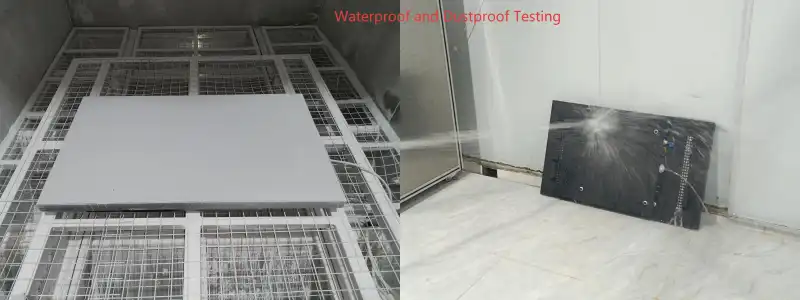
IP55 denotes that the enclosure is dust-protected, the first 5. Some dust could get in but not enough to interfere with regular functioning. The second 5 signifies that the container is protected from water jets from any direction. The lab test employs a 6.3mm nozzle delivering around 12.5 liters per minute from about 3 m away. IP55 is ideal for kiosks under canopies, covered entrances, restaurant terraces, and campus pathways. In some regions, rain hits the unit at a low angle, and pressure cleaning is not done often. Does not guard against immersion.
What IP66 Covers
IP66 is more about the enclosure on both numbers. The first 6 is dust-tight; thus, a vacuum-assisted dust test must show no dust within. The second 6 signifies protection against intense water jets. Tested with a 12.5 mm nozzle at roughly 100 liters / minute. That is around eight times the water flow of the IP55 test. This category is for exposed areas subject to heavy rain, wind-blown spray, road dust, or frequent hose cleaning. As an IP55, it does not protect against immersion. Immersion: IPX7 and IPX8 rated.
| IP Rating | Dust Protection(First Digit) | Water Protection (Second Digit) | Description |
| IP56 | 5-Dust-protected(limited ingress,no interference with operation) | 6-Powerful water jets | Good for outdoor use;resists dust and strong water spray |
| IP65 | 6-Completely dust-tight | 5-Water jets | Total dust protection and resistant to water spray from any direction |
| IP66 | 6-Completely dust-tight | 6-Powerful water jets | Higher water resistance than IP65; withstands stronger water pressure |
| IP67 | 6-Completely dust-tight | 7-Temporary immersion(1 meter for 30 minutes) | Dustproof and waterproof,safe for short- term submersion |
IP66 vs. IP55 Outdoor Digital Signage: Key Differences and Performance Factors
Sealing and Cost
The practical gap is the seal. An IP66 outdoor digital signage enclosure requires tighter gaskets, sealed service doors, covered cable glands, and a drainage channel that passes testing. IP55 will allow a minor leak channel as long as it does not let dangerous dust or water into the enclosure. Installation is important. A freshly drilled hole, a faulty connection, or a worn door gasket might reduce the approved level. IP66 devices tend to be more expensive up front because of the extra sealing and thermal engineering. They may reduce service visits and downtime in difficult situations. So I would suggest comparing overall cost of ownership, including energy, replacement parts, and warranty claims, not just unit pricing.
Thermal Design Sets the Limit
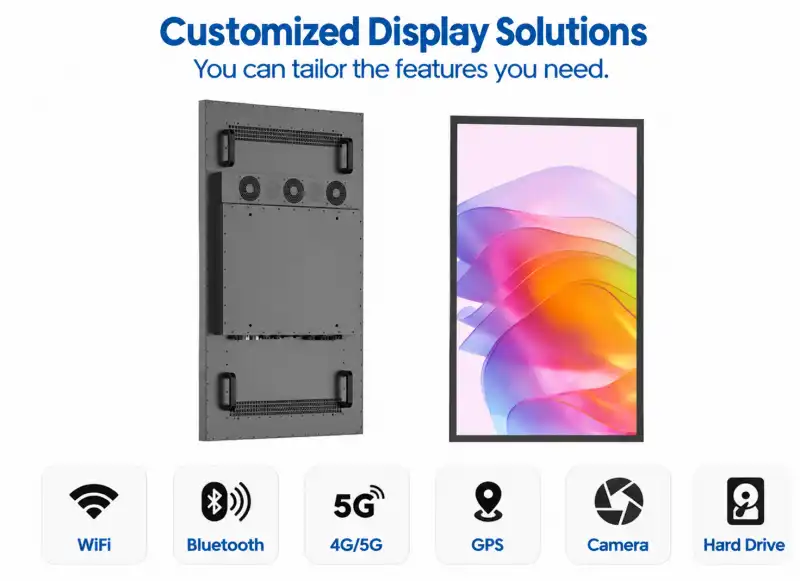
A sealed cabinet retains heat, and a heated panel becomes unreadable. Fully sealed designs use heat exchangers, air conditioners, or passive cooling. Filtered-air designs need shielded intake routes. That’s why cooling and IP rating are discussed together. Our T32SO, T43SO, T49SO, and T55SO include intelligent direct-wind temperature management, a high-precision filtration system, and military-grade heat dissipation technology. The cooling system is designed to function in -20°C to 45°C conditions with an internal temperature range of 5°C to 25°C. Designs are different, so I would suggest contacting any provider for the IP test report for the precise cooling configuration.
Performance Beyond Waterproofing
Coding an IP won't cure a dim screen. Direct sunlight demands high brightness, anti-glare glass, UV-resistant materials, and automated brightness management. Our T-series has an LED-backlit LCD with 1500 or 3000 nits and 1920 x 1080 ,3840x2160(4K)resolution. Its LCD substrate temperature range is -30 °C to 110 °C. The AR glass can block 99.99% of UV and 52% of solar radiation heat; its light transmittance is over 97%, and its reflection is below 3%. Buyers may also consider IK ratings under IEC 62262, which rate impact resistance from IK00 to IK10. See corrosion classifications in ISO 12944 for coastal locations.
Which Outdoor Environment Suits IP55 or IP66?
Where IP55 Is Enough
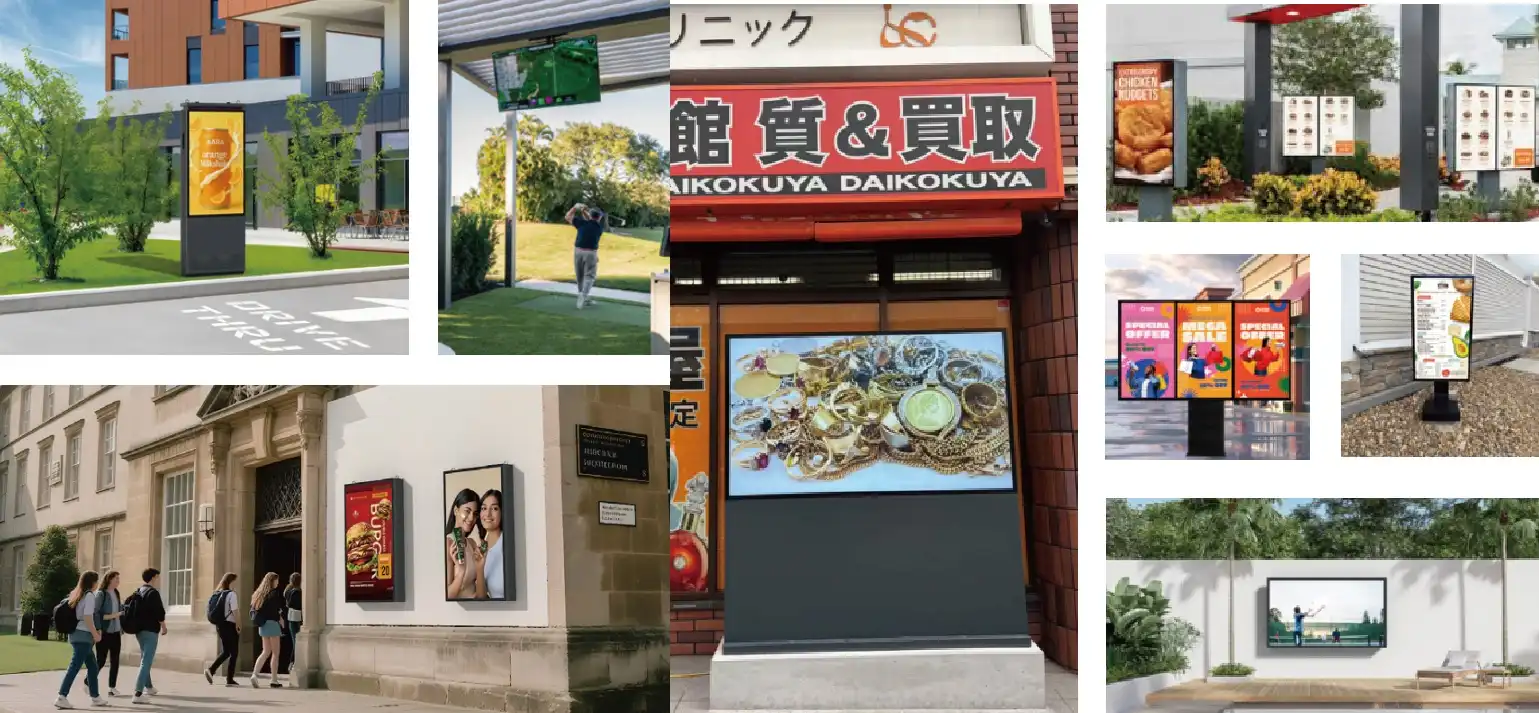
IP55 makes sense with a display that has actual shelter. Consider covered mall entrances, restaurant terraces, business parks, campus walkways, units housed behind protected kiosks or cabinets. In certain locations, rain seldom strikes the screen head-on, dust remains mild, and technicians may access the device quickly. The cost of IP66 might blow the budget without much added benefit. For store chains and mall managers putting up dozens of screens, that’s a big save. I would still look at the local rainfall and wind statistics before deciding to go with the lesser grade.
Where IP66 Is the Safer Choice
IP66 is appropriate for completely exposed places: roadside advertising, airports, transit stations, stadiums, public squares, construction sites, industrial sites, coastal sites, and uncovered drive-through lanes. Wind-driven rain, road dust, salt spray, and hose washing all stress the seals. The additional sealing pays for itself when a faulty screen costs ad revenue or puts tourists in the dark. NEMA enclosure types will also be seen by US purchasers. NEMA 250 has a table listing Type 4 next to IP66; however, the specification says you can’t use an IP code to claim a NEMA type. Request the correct papers.
A Simple Decision Rule
Pick the lowest rating that will work under your actual site circumstances, not the cheapest one. Use IP55 for shielded display, moderate exposure, and simple access for servicing. Choose IP66 if the unit will be exposed to rain, dust, mist, coastal air, or regular pressure washing, or if the location is difficult to maintain. If circumstances are unknown or expected to deteriorate, an IP66 or bespoke enclosure provides better long-term value. A pilot installation also helps. Before placing a volume order, it examines visibility, thermal performance, humidity, power consumption, and network stability.
Procurement Guide: Cost, Mistakes, and the Topview T-Series
Pricing Drivers and Common Mistakes
Factors affecting the cost of Solar Panel Outdoor Digital Signage include screen size, resolution, brightness levels, enclosure rating, cooling systems, glass type, CMS (Content Management System), connection options, mounting options, certifications, and logistics. To receive an exact price, you’ll need to send us the dimensions, climatic data, installation technique, hours of operation, brightness goal, and delivery location. Then avoid four typical errors. IP66 is not waterproof; it is resistant to intense jets of water, but not to immersion. Don’t sacrifice brightness and temperature range chasing the IP rating. Do not alter the enclosure after delivery. Don't just go for the cheapest unit pricing without first comparing test results, warranty, and spare-parts support.
T32SO, T43SO, T49SO, and T55SO Features
Our T-series is a solar-powered outdoor digital signage with no cabling or electrical connections, which helps in areas where trenching is pricey. The solar battery is deep-cycled with gel electrolyte and overcharge/over discharge protection. The cabinet is made of 1.5 mm galvanized steel with external powder coating, color may be customized, shell life span over 7 years. Inside, you have a built-in network player board, with an optional industrial control computer and an optional multi-touch screen. The units are FCC, RoHS, and CE certified. Don’t depend on a generic statement; get the tested IP report for your setup.
OEM Support, Terms, and Warranty
Topview has been making LCD advertising displays in Shenzhen for over 13 years. We have a 2000 square meter workshop, 3 manufacturing lines, more than 20 engineers, 2 after-sales engineers, daily output up to 100 items. We have our own housing plant and an R&D staff of no less than 10 people. We are happy to consider OEM and ODM projects. We can customize logos, colors, brightness, and software, and there is no MOQ for modification. Price Terms: EXW, FOB, DDP. Payment Terms: T/T. Packing: Reinforced wooden case. 5-15 business days lead time. The standard warranty is 1 year, extendable up to 3 years, including technical assistance.
Conclusion
The difference between IP66 and IP55 is the level of exposure. IP55 offers dust protection and water jet protection, ideal for covered or semi-sheltered locations. IP66 is dust-tight and can withstand much stronger water jets, which makes it good for completely exposed settings with heavy rain, road dust, salt air, or regular cleaning. The grade just tells you about the enclosure; true Outdoor digital signage performance is still determined by brightness, anti-glare glass, cooling, impact resistance, anti-corrosion, and installation quality. The T-series example illustrates the combination of several variables in one product. The decision should be based on total cost of ownership, not unit pricing. Normally the lowest rating that suits the actual site is the greatest bargain.
FAQ
1. Is IP66 always better than IP55?
No. IP66 gives stronger dust and water-jet protection, but sheltered sites may only need IP55. Match the rating to real exposure and weigh the extra cost against service savings.
2. Does IP66 mean the display is readable in direct sunlight?
No. The IP code covers enclosure protection only. Sunlight readability depends on brightness, anti-glare glass, and cooling. Our T-series offers 1500 or 2000 nits and adjusts brightness automatically with a photosensitive sensor.
3. Can outdoor digital signage run without a power cable?
Yes, if it is solar-powered. The T32SO, T43SO, T49SO, and T55SO run on solar energy 24/7 with no wiring or electrical connections. Share your location and operating hours so our engineers can review your project.
4. Does Topview accept custom orders?
Yes. We accept OEM and ODM projects, including custom color, logo, brightness, and software, with no MOQ for customization.
Request a Quote for Outdoor Digital Signage From Topview
Ready to compare IP55 and IP66 for your project? Topview, a Shenzhen outdoor digital signage manufacturer with 13 years of LCD experience, can review your site data and recommend a suitable T-series configuration. Email market@tviewdisplay.com with your screen size, location, brightness target, and quantity for details. We support OEM and ODM requests, with no MOQ for customization and a 5-15 workday lead time.
References
1. IEC 60529: Degrees of Protection Provided by Enclosures (IP Code), International Electrotechnical Commission, 2013
2. NEMA 250: Enclosures for Electrical Equipment (1000 Volts Maximum), National Electrical Manufacturers Association, 2020
3. IEC 62262: Degrees of Protection Provided by Enclosures for Electrical Equipment Against External Mechanical Impacts (IK Code), International Electrotechnical Commission, 2002
4. ISO 12944-2: Paints and Varnishes, Corrosion Protection of Steel Structures by Protective Paint Systems, Part 2: Classification of Environments, International Organization for Standardization, 2017
5. Code of Federal Regulations, Title 47, Part 15: Radio Frequency Devices, Federal Communications Commission, 2023
6. Directive 2011/65/EU on the Restriction of the Use of Certain Hazardous Substances in Electrical and Electronic Equipment (RoHS), European Parliament and Council of the European Union, 2011