



Can outdoor solar display Run at Night?
Yes, an outdoor solar display may be used at night, as long as its battery has enough energy to last throughout your operating hours. Solar panels capture electricity throughout the day. That electricity is sent to a charge controller, and the battery powers the screen when the sun goes down. The runtime depends on screen brightness, content, daily use pattern, local sunshine conditions, battery condition, and temperature. But a panel by itself can't run a screen in the dark, so the battery capacity is more important than most purchasers think. Below I describe how night operation works, what to check in a product, and how to purchase one.
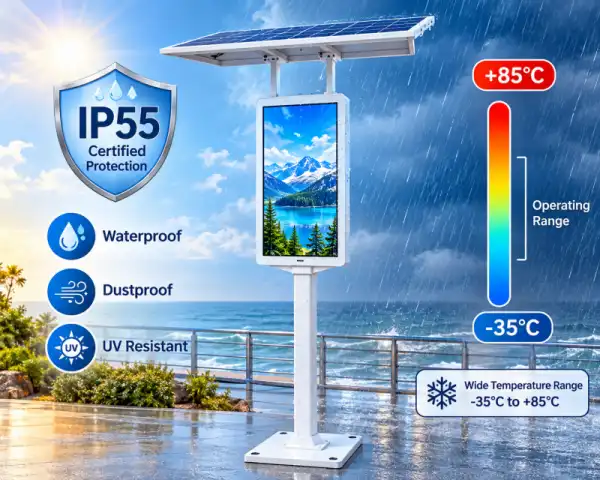
How an Outdoor Solar Display Works After Dark
Daytime Charging and Night Discharge
Photovoltaic (solar) panels generate power from sunshine throughout the day. A charge controller controls that current to charge the battery safely and to cease charging when full. The panels generate nothing after sunset, and the sole source of electricity is the battery. Good controllers also switch off power at a certain level of discharge, since continuous deep discharge will reduce battery life. Batteries in a Portable World by Isidor Buchmann: Depth of Discharge and Cycle Life. So, I would say the heart of any solar digital signage system that can operate at night is the battery and the controller, not the panel size.
What Sets Night Runtime
Night runtime is really basic math. The operating hours are the usable battery capacity divided by the average power consumption of the screen. The LED backlight needs more power at greater output; therefore, those that pull more are driven by brightness. A screen lowered for nighttime viewing runs longer than a panel at full daytime brightness. The media player and cooling fans also use electricity. I suggest increasing reserve capacity for overcast days and for battery aging. IEEE Std 1562-2007 provides guidelines on how to size stand-alone solar arrays and batteries, including how to account for days with autonomy. The actual time will always vary depending on the model and battery arrangement you pick.
Weather and Temperature Effects
The amount the panels can recharge each day depends on the weather. Clouds, shadow, snow, dust, and bird droppings all limit panel output; thus, the system requires a cushion for low-sun periods. Thus, the Sandia National Laboratories Handbook for Stand-Alone Photovoltaic Systems includes array and battery maintenance. Temperature is also important in the battery. Isidor Buchmann’s battery study shows that cold weather reduces the amount of power a battery can provide, while heat shortens the battery’s life. That’s why I always ask customers what the lowest and highest local temperatures are before I propose a layout. What works as a design in Arizona may have to be modified for Minnesota.
Topview T32SO, T43SO, T49SO, and T55SO Features for Night Use
Bright Screen and Smart Dimming
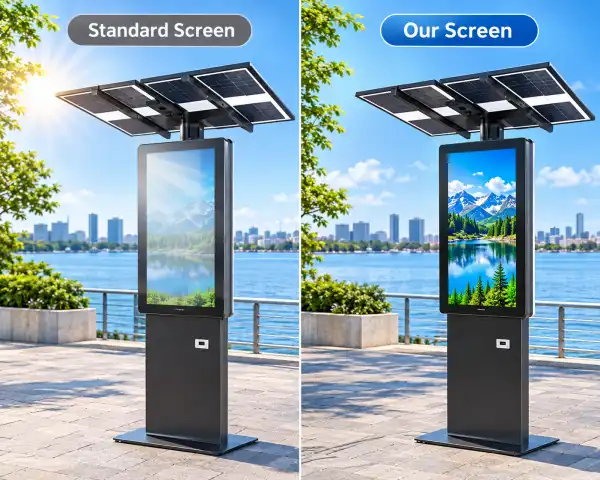
The four variants include a 1500 or 2000 nits high-brightness LED-backlit LCD screen, so information remains clear in sunshine. An automatic photosensitive probe can change the brightness according to the surrounding light at night. A dimmer nighttime brightness consumes less energy and prevents screen aging, so the battery power stored in it lasts longer. The outdoor solar display resolution is up to 1920 x 1080, and the colors are accurate and brilliant. The LCD substrate operates from -30°C to 110°C, which allows for quick start-up and excellent visuals under frigid temperatures. I appreciate this combo since the one screen handles both a sunny day and a dark parking lot without manual adjustments.
Glass, Cabinet, and Cooling
The glass and cabinet protect the screen from the weather and heat. Topview’s vandal-proof glass is 6mm double-sided laminated glass with an AR anti-glare coating. Blocks 99.99% UV and 52% of solar radiation heat, offering more than 97% light transmission with less than 3% reflectance. The cabinet is made of 1.5mm galvanized steel with outdoor powder coating in your chosen color. The shelf life is more than 7 years. Military-grade heat dissipation, smart temperature regulation, and a high-precision filter system protect the LCD from blackening in direct sunlight. For places subject to storms, the enclosure is rainproof, waterproof, and dustproof. Colors may be brand-consistent.
Battery, Controls, and Content Management
The solar battery is capable of deep cycling and will withstand overcharging and over-discharging. It has gel electrolyte and a specific design process to support a long life. It operates in many settings, like high altitude and high heat. An electric control system includes a circuit breaker, segmented timers, and automated power on and off, so it's possible to create nightly routines. The integrated network player board allows photos, video, and text, offline file playback, and server administration software. Optional extras include an industrial control computer and a multi-touch screen. The standard guarantee is one year, up to three years available, and free technical assistance after the warranty expires.
Solar Signage Versus Grid-Powered Displays
Installation and Cost Differences
A grid-powered display requires trenching, cabling, and an electrical hookup at the location. These measures add to permit time and civil work, particularly in parks, highway stop areas, and temporary lots. A solar unit requires a base and a good view of the sky, but no power cable. Topview versions are easy to install with no wiring or electrical hookups required on site. The tradeoff is energy planning. Solar systems need careful sizing, shading monitoring, and a strategy for battery replacement over time. I would suggest purchasers look at the overall cost of ownership, including installation, maintenance, replacement parts, and servicing, not just the screen price.
Applications That Need Night Visibility
Night operation is very important when people read signs at night. Transit authorities use Solar Panel Outdoor Digital Signage-powered signs at bus stops and stations to update schedules without digging up the pavement. Used for navigation, weather warnings, and tourist information in parks and eco-tourism places where wiring is limited. Construction and real estate teams use portable devices on live project sites to display visuals and safety warnings before permanent power is available. It’s also used for retail lots, parking places, and event location menu information and advertising. Brightness, scheduling, and battery requirements will fluctuate from case to case. First of all, viewing distance and operation hours should be determined.
Who Buys and Why
Different purchasers want different stuff. Procurement managers assess cost-performance, lead time, and certifications. Topview’s models are certified by FCC, RoHS, and CE. AV integrators and project managers demand technical documentation, flexible configuration, and replies from experts – quickly. The margin, consistent batch quality, and private labeling are the main considerations of distributors and importers, which Topview supports with OEM and ODM services. EPC and tender customers are concerned about the manufacturing capacity and delivery timetable. Topview can produce up to 100 units per day, which is important for bulk and project orders. Topview also has its own housing factory, so cabinet color, logo, and structural modifications are all done in-house.
How to Specify and Order a Night-Ready Solar Display
Specifications to Define First
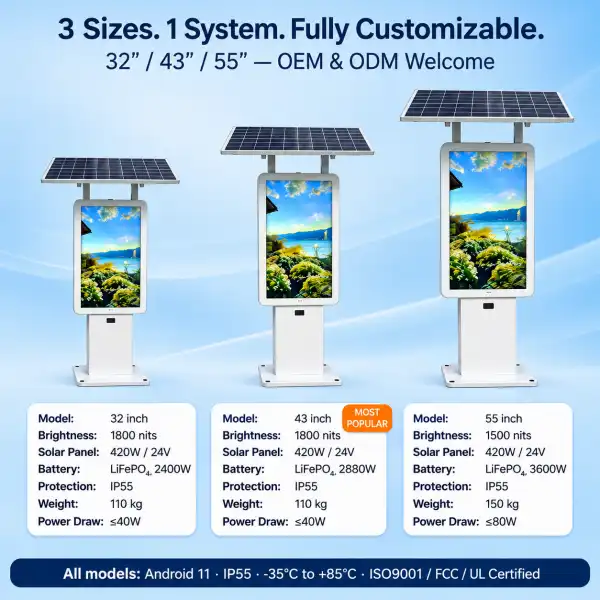
A clear brief avoids the system becoming too small. Before you ask for a price, write down the screen size, viewing distance, where it’s going to be installed, shading, how many hours a day it will be used, and what sort of information you’ll be displaying. Add the lowest and maximum local temperatures, your content strategy (wired network, offline files, etc.) Specify the number of days the screen has to be in overcast conditions. Ask the provider to provide you in writing the battery capacity, panel output, and estimated night runtime for your precise set-up. Check the IP rating and wind load for your location also. The IP code is defined in IEC 60529, thus you may compare enclosure claims to a recognized standard.
Common Buying Mistakes
The most common error is to look at a system by panel size and ignore the battery. Another is sizing for just sunny weather, and then dealing with limited run periods in winter. Buyers also use full brightness all night, which consumes the battery and causes glare for surrounding neighbors. Some consumers compare estimates on screen pricing and skip out on things like the controller, the mounting framework or the software. Lost charging hours because no shade check at site. At last purchasers neglect to inquire about spare parts and battery replacement. These are caught early by routine inspections, and I would propose to incorporate a maintenance plan in the purchase agreement.
Trade Terms, Lead Time, and Factory Support
Terms of Payment: T/T. Terms of Delivery: EXW, FOB, DDP. Lead time: 5-15 workdays. Orders ship in reinforced wooden crates. We have been making LCD advertising displays at our Shenzhen facility for over 13 years. The 2,000-square-meter workshop has three manufacturing lines, more than 20 senior engineers and assembly helpers, and two after-sales engineers. Unique work, including silk-screen or LED-illuminated logos, power-on logos, unique software, and specific built-in devices, employs at least 10 workers. Customization is available without MOQ. Give us your site info, and we will size the arrangement around your night-time hours.
Conclusion
An outdoor solar display may operate at night, since the battery stores energy the panels gather during the day. Night duration will depend on available battery capacity, brightness on the screen, schedule, weather, and temperature. So, system sizing may be more important than panel size alone. The screen performs in sunshine and darkness with automatic dimming, a protective cabinet, good cooling and anti-glare glass. Solar systems at bus stations, parks and construction sites save trenching and wiring, but need planning and battery maintenance. Buyers that specify site circumstances, hours and content requirements and demand detailed run-time calculations may compare quotes apples-to-apples and choose a system that meets their night-time needs.
FAQ
1. Can an outdoor solar display run all night?
Yes, when battery capacity, solar charging, brightness, and schedule match each other. A screen with automatic dimming and a correctly sized battery can run through the dark hours. Runtime for a specific model depends on its configuration, so ask for a written calculation.
2. What is the difference between runtime and battery life?
Runtime is how many hours the screen runs per night. Battery life is how many years the battery performs before replacement. Deep discharge, heat, and cold shorten battery life. Topview's solar battery uses a gel electrolyte and a special process design for long life.
3. What happens on cloudy days?
Clouds reduce the energy the panels collect, so the battery refills more slowly. A good design includes reserve capacity for several low-sun days, and dimming schedules help stretch stored power. Share your location so the system can match local weather.
4. What does Topview need to quote?
Send the screen model (T32SO, T43SO, T49SO, or T55SO), site location, viewing distance, daily operating hours, content type, and shading details. Our team will reply with a configuration suited to your hours.
Request Your Outdoor Solar Display Quote from Topview
Topview is an outdoor solar display manufacturer in Shenzhen with 13 years of LCD advertising display experience, OEM and ODM service, and no MOQ for customization. Our models carry CE, FCC, and RoHS certification. Send your site details and target operating hours to market@tviewdisplay.com, and our engineers will recommend a T32SO, T43SO, T49SO, or T55SO configuration.
References
1. Isidor Buchmann, Batteries in a Portable World, 4th Edition, Cadex Electronics, 2016.
2. IEEE, IEEE Std 1562-2007, Guide for Array and Battery Sizing in Stand-Alone Photovoltaic Systems, 2007.
3. IEC, IEC 60529: Degrees of Protection Provided by Enclosures (IP Code), 2013.
4. Sandia National Laboratories, Stand-Alone Photovoltaic Systems: A Handbook of Recommended Design Practices, 1995.
5. Roger Messenger and Amir Abtahi, Photovoltaic Systems Engineering, 4th Edition, CRC Press, 2017.
6. Thomas B. Reddy (Editor), Linden's Handbook of Batteries, 4th Edition, McGraw-Hill, 2010.