



Outdoor Solar-Powered Digital Signage: The Complete Buyer’s Guide
Outdoor solar digital signage is a standalone display system that includes photovoltaic panels, battery storage, a weatherproof screen, and a media player, enabling it to operate independently of a grid connection. When trenching and utility connections are too costly or take too long, buyers select solar digital signs. The proper decision relies on the screen brightness, the energy consumption each day, the battery backup, the local sunshine, and the provider assistance. This handbook addresses all of them. It then demonstrates how the Topview T32SO, T43SO, T49SO, and T55SO models meet the demands of distributors, integrators, and procurement teams.
How Solar Digital Signage Works and Where It Fits
How a Solar Digital Signage System Works
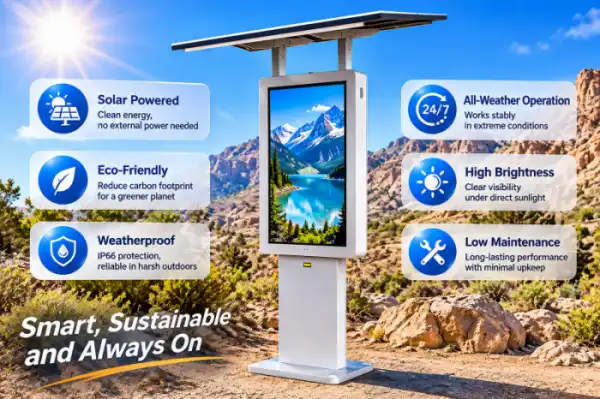
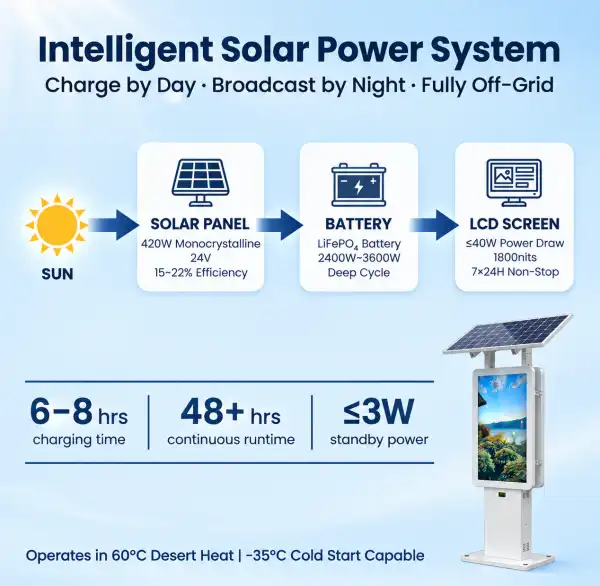
Solar panel outdoor digital signage is an off-grid display that converts sunshine into stored energy. Photovoltaic panels gather electricity throughout the day. The charge controller controls the current and prevents the battery from overcharging and deep discharging. The battery powers the display, media player, sensors, and cooling gear at night and under cloud cover. A network connection enables operators to update material without visiting the site, and the media player scrolls over programmed pictures, video, and text. Unlike a static solar sign, the screen is able to cycle multiple messages in a single day. This flexibility is appropriate for transportation information, store promotions, event notifications, and public service announcements when no power line is present.
Key Benefits for Outdoor Use
The biggest benefit is independence from the electricity grid. You can put a screen at a parking lot, trailhead, highway pull-off, or construction site considerably quicker, without trenching, cabling, or utility hook-up. This is the premise behind the Topview T32SO to T55SO series: the devices operate on solar energy and do not need any on-site cabling or electrical connections. Operators may also save on their power costs and disclose the usage of greener energy in sustainability initiatives. The engineering is a little more careful than a plug-in display, but on distant sites the savings in civil work frequently justify it. Changing content also has the ability to generate cash, since one screen may host several sponsors or campaigns.
Solar vs. Grid-Powered Signage and LED Billboards
Each power choice has its place. Grid-powered displays are easy to operate from an energy standpoint, perform better in low-sunlight areas, but need wiring that may be expensive to install. They use very little energy, but they are static and cannot alter messages. Large LED billboards have a vast reach but need significantly larger Solar Panel Outdoor Digital Signage arrays and battery banks due to their power requirements. In the center, there is a solar-powered LCD sign. It has dynamic content for pedestrian and short-range viewing, and avoids hefty infrastructure. It makes the most sense for off-grid sites, transitory operations, fast rollouts, and where environmental aims warrant the additional energy design.
Selecting and Sizing Outdoor Solar-Powered Digital Signage
Choosing Screen Type, Brightness, and Weather Protection
Start with the application, distance of view, and operation hours. LED panels perform well for huge formats and long viewing distances, while high-brightness LCD is ideal for crisp, close-range material like maps, menus, and timetables. The most important factor is brightness, since sunshine will wipe out a regular indoor display. Topview series has high-brightness LED-backlit LCDs, 1500 or 2000 nits, with resolution up to 1920 x 1080. Weather protection is equally important since enclosures are subject to rain, dust, UV, heat, wind, and snow. Ask any provider for the tested rating of the actual enclosure, not a generic assertion. IP ratings are defined in the IEC 60529 standard.
Power Requirements and Battery Backup
Power planning is the success of a project. Not simply the screen-rated watts, but calculate the daily energy consumption of each load, such as display, player, communication module, sensors, cooling fans. Then size the panels to local peak solar hours, seasonal weather, shading, and panel angle. US customers may get a handy baseline from the National Renewable Energy Laboratory’s PVWatts Calculator, which forecasts solar output based on site-specific meteorological data. The choice of battery is determined by its useful capacity, cycle life, temperature, and the number of backup days. The site-specific algorithm avoids night-time shutdowns, dull displays, and early battery wear during overcast periods.
Matching Configurations to Buyer Needs
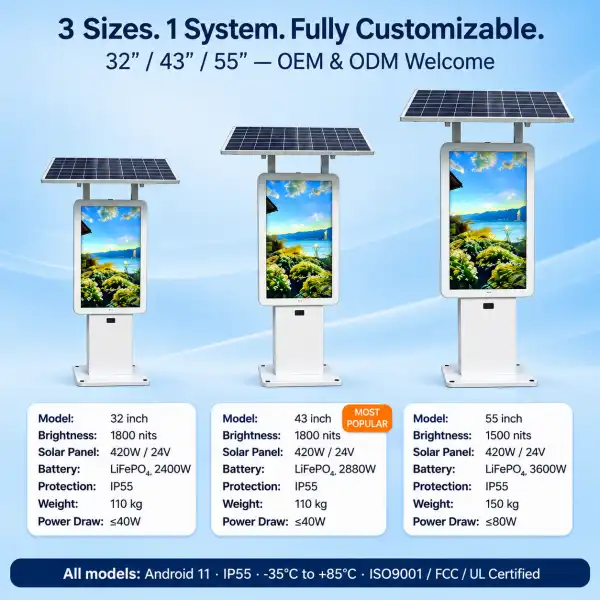
Different purchasers think different things. For the advertising operators, it is all about brightness, uptime, and campaign management. Retailers and malls worry about excellent images and branding. Remote locations need rugged cabinets, extended battery backup, and easily replaceable parts. “Event companies want units that are mobile and deployable fast. Distributors and OEM purchasers want a full variety with private label options.” Topview has four models, T32SO, T43SO, T49SO, and T55SO, and enables OEM and ODM work. This includes silk-screen or LED-illuminated logos, bespoke colors, a power-on logo, and customized software. There is no MOQ requirement for customization, so integrators may acquire project-specific components without committing to large quantities.
Topview T32SO, T43SO, T49SO, and T55SO Solar Digital Signage
Display and Glass Specifications
The series is equipped with an industrial-grade LED-backlit LCD panel with 1500 or 2000 nits brightness and a resolution of up to 1920 x 1080. The LCD substrate is rated to operate between -30°C and 110°C, which is good for rapid start-up in cold conditions and crisp visuals under heat. The front glass is US-made AR glass of 6 to 10 mm, which is UV- and infrared-resistant and insulating against heat. 6 mm double-sided laminated glass is vandal-resistant and blocks 99.99% of UV and 52% of solar radiation heat. The light transmittance surpasses 97%, while the reflectance is below 3%. The photosensitive automated probe adjusts brightness to suit the surrounding light, saving power and slowing screen aging.
Battery, Cabinet, Cooling, and Control Features
The system is provided with an outdoor solar-powered digital signage battery which has good deep cycling, overcharge, and over-discharge capabilities. Its gel electrolyte allows extended life in high-altitude and high-temperature circumstances. The cabinet is made of 1.5mm galvanized steel with outdoor powder coating, color determined by the client, with a shell life of more than 7 years. The intelligent air temperature management allows the machine to function in an environment from -20°C to 45°C, and the interior temperature is kept between 5°C and 25°C, so that the screen will not blacken in direct sunshine. A high-precision filter ensures airflow protection. A built-in network player board manages photos, video, and text, offline playback, and server administration software. Optional industrial computer and multi-touch display.
Certifications, Terms, Packing, and Warranty
The series is FCC, RoHS, and CE marked. 47 CFR Part 15 FCC regulations regulate electronic devices for sale in the United States. The EU RoHS Directive 2011/65/EU prohibits hazardous compounds in electronic equipment. Payment: T/T, EXW, FOB, DDP. Each item is delivered in a reinforced wood box, and the lead time is 5 to 15 working days. The normal guarantee is for one year, extendable to three years. Topview also offers free technical help even after the warranty period has expired. Our Shenzhen factory specializes in LCD advertising display manufacturing for more than 13 years, and the daily output may reach 100 units.
Installation, Maintenance, Cost, and Supplier Checks
Installation and Commissioning
A proper installation begins with a site inspection to determine sun exposure, shade, ground conditions, wind and snow loads, viewing angles, traffic movement, and municipal permissions. Arrange the panels and the screen such that one does not shade the other. “Foundations and mounts need structural calculations and corrosion-resistant materials, and the layout should provide space for safe service access. The electrical plan is for grounding, fuses, disconnects, and surge protection. During commissioning, test charging, night operation, network connections, brightness management, low battery behavior, weather sealing, and structural stability before final acceptance. During this phase, our after-sales experts are available to address technical issues and assist in keeping integrators and EPC contractors on schedule.
Maintenance and Lifecycle Cost
Better to plan maintenance than emergency repair. Clean panels of local dust, snow, pollen, and pollutants. Dirt lowers energy generation. Monitor for moisture, restricted airflow, worn seals, broken parts in displays and cabinets, and monitor the battery voltage and charging behavior over its life. When comparing quotes, ask for a full bill of materials and distinguish between nominal and usable battery capacity. The budget must include: foundations, shipping, installation, permits, spare parts, labor, and future battery replacement. A low price hides poor weatherproofing or excessive power demand, which adds up to overall cost eventually.
Supplier Evaluation, Common Mistakes, and Final Checklist
Buyers typically assess the appearance alone, overlooking the complete energy and structural design. Panels or batteries that are small cause shutdowns and dull displays, and average sunshine statistics for a year might be misleading in overcast winters. Check the application, brightness, resolution, backup days, certifications, warranty terms, packaging, Incoterms, lead time, and availability of replacement parts before placing an order. Then assess supplier capability. Topview has a 2000 square meter workshop, 3 manufacturing lines, more than 20 senior engineers and assembly personnel, an in-house housing factory, and an R&D team of at least 10 people. Samples and project information are requested before bulk ordering.
Conclusion
Outdoor solar digital signage allows purchasers to display changeable material in locations where grid electricity is pricey or not accessible. A successful project is one where the screen type, brightness, weather protection, panel size, and battery backup are matched to the location and operation schedule. Solar-powered signs are more suited for off-grid and temporary locations than grid-powered signs or giant LED billboards that need wiring or much larger energy systems. The Topview T32SO to T55SO series has a 1500 or 2000 nit display with AR glass, a galvanized cabinet, a cooling system, and a network player. Results also depend on installation quality, maintenance, and lifespan cost. Quotations should thus include every component and service. Technical and financial risk is reduced by careful energy calculations, validated certificates, clear contracts, and established production capacity.
FAQ
1. Can solar digital signage run at night?
Yes. Batteries store the energy that panels collect during daylight and power the screen after dark. The required backup time, from one day to several days, depends on climate, operating hours, uptime goals, and display power draw. A site calculation sets the right battery size.
2. Does it work in cloudy weather?
Yes, when the design uses local sunlight data, reserve battery capacity, and automatic brightness control. The Topview series includes a photosensitive probe that lowers brightness when ambient light drops, which saves energy.
3. Is the screen readable in direct sunlight?
The T32SO to T55SO models use LED-backlit LCD panels at 1500 or 2000 nits with AR-coated glass, which keeps content clear in all-day sunlight.
4. What are the lead time and warranty terms?
Lead time is 5 to 15 workdays. The default warranty lasts one year, with up to three years available, and free technical support continues after the warranty ends.
Request Topview Solar Digital Signage for Your Project
Topview is a Shenzhen solar digital signage manufacturer with 13 years of LCD advertising display experience, OEM and ODM services, and no MOQ requirement for customization. Send your site location, screen size, operating hours, and order volume to market@tviewdisplay.com, and our team will prepare a technical proposal and quotation.
References
1. National Renewable Energy Laboratory, PVWatts Calculator, 2024
2. International Electrotechnical Commission, IEC 60529: Degrees of Protection Provided by Enclosures (IP Code), 2013
3. U.S. Code of Federal Regulations, Title 47, Part 15: Radio Frequency Devices, 2023
4. European Parliament and Council, Directive 2011/65/EU on the Restriction of Hazardous Substances (RoHS), 2011
5. Sandia National Laboratories, Photovoltaic Array Performance Model, 2004
6. Solar Energy Industries Association, Solar Market Insight Report, 2024
YOU MAY LIKE
 VIEW MOREUltra Thin Super Slim Display Indoor Digital Display Screen
 VIEW MORE32inch Outdoor LCD Totem Signage
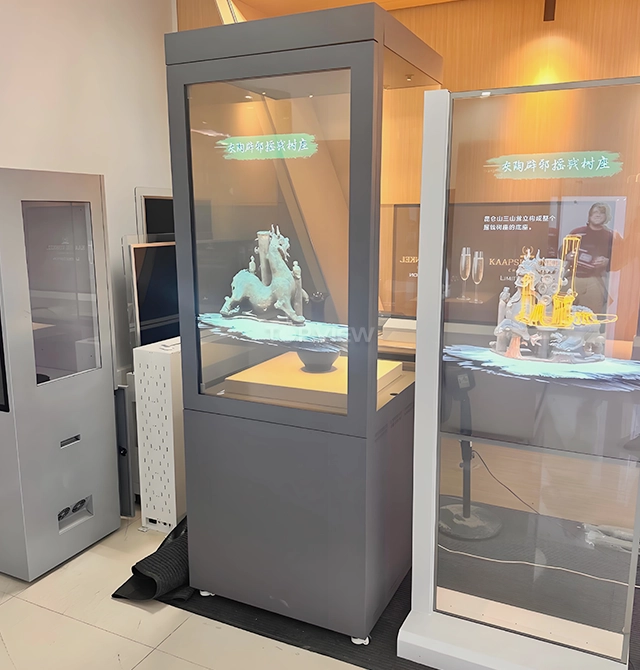 VIEW MORE55″ Transparent OLED Display Cabinet
 VIEW MOREWooden Frame Digital Signage
 VIEW MOREInteractive touch tables
 VIEW MORECustom Printing Self-Service Kiosk
 VIEW MOREH-Style Floor Stand Totem Digital Kiosk
 VIEW MOREoutdoor ev charging kiosk