



How solar digital signage works
Solar digital signage uses sunlight to generate stored energy to power an outdoor sign. The photovoltaic panels convert sunshine into DC electricity, and a charge controller transmits that power to a battery. The battery powers the screen, media player, and sensors, even at night and on cloudy days. Software then handles playlists, brightness, and scheduling, sometimes via a network connection. Parks, parking lots, transit stations, and work sites are perfect for off-grid units that don’t need trenching or utility connection. This tutorial walks you through each element of the system and what you need to look for before making your purchase.
How Does Solar Digital Signage Work?
How Solar Digital Signage Generates and Stores Energy
All systems start with photovoltaic panels. When the cells are touched by sunlight, they create direct current. The charge controller lies between the panel and the battery. It regulates voltage and current to prevent overcharging the battery so that it charges securely. The battery then stores that energy until the display needs it. Panels also lose some output each year. NREL researchers who analyzed field data observed a median deterioration rate of roughly 0.5 percent per year; thus, a sound design allows for that loss. I also inquire about the location of the installation initially, since dust, snow, and shadow may reduce output.
Main Components of a Solar Digital Signage System
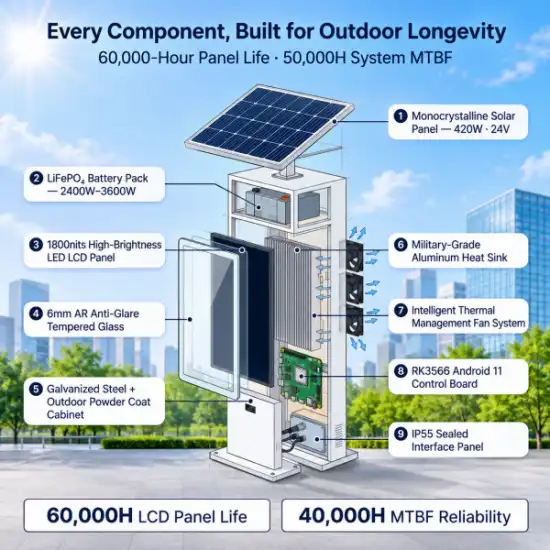
A commercial unit is more than just a screen and a panel. The display has to be viewable in sunlight while saving electricity. Battery covers nights and bad weather. Converters provide the proper voltage to the screen and the player. The electronics are housed in a weatherproof cabinet to protect against rain, dust, and tampering. The IP ratings that purchasers commonly seek are defined by the IEC 60529 standard. One player on the network streams stuff to the screen. Extra loads like cooling, sensors, or a touch module contribute to the power budget, so I count on them from the outset of every design. These pieces make up a system. If any of these pieces has a weak link, the screen may be left black.
Controls, Content Delivery, and Brightness Management
The software binds the hardware together. A network player gets photos, video, and text scheduled by an administrator from a server. Timers turn the screen on and off automatically so it doesn't use power while no one's watching. A light sensor senses the surrounding environment and changes the screen brightness, saving energy at night and reducing wear on the backlight. Topview’s built-in player board enables offline files and network playback, and our server administration software controls content. This is important at distant locations where every technician visit costs time and money. Smart scheduling may extend battery life without altering any hardware.
Power Requirements and Battery Backup for Solar Digital Signage
How to Calculate Solar Digital Signage Power Requirements
Begin with measured energy usage, not screen size. Real Operating Wattage times Daily Operating Hours. Then add the losses of the player, router, sensors, cooling, heating, and conversion. The sum is your daily watt-hour load. Then verify local sunlight. NREL’s Solar Radiation Data Manual provides solar digital signage resource data, by location, that installers use to predict peak sun hours. Divide the daily load by those hours and add a buffer to account for shade, dust, age of panels, and temperature. A sign in Seattle requires a different array than a sign in Phoenix, even if the screen is the same. When you ask for a price, tell us about your location, brightness, timetable, and accessory loading.
Solar Digital Signage Battery Backup: Capacity, Runtime, and Life
Battery size is an easy calculation: daily energy usage multiplied by the number of backup days you desire, divided by the usable depth of discharge. For example, a 1,000 Wh per day load with two days of backup and a depth of use of 80 percent requires a rated capacity of 2,500 Wh. Lithium iron phosphate batteries generally have longer cycle life and need less maintenance than lead-acid; however, lead-acid may be cheaper initially. Topview’s solar battery has a gel electrolyte and has strong deep cycle capabilities with prevdeep-cycleovercharge and over-discharge. Cold, heat, and lengthy periods of cloudiness will lower the usable capacity; thus, check the design for your environment. Batteries, panels, and displays each have a different aging rate; therefore, design each lifespan individually.
Solar Digital Signage Compared with Grid-Powered Signage
Static signs need a person and a ladder each time the message needs to be updated; digital signs update from a server. Solar devices eliminate trenching, utility coordination, and energy usage compared to grid-powered digital signage. They normally cost more upfront, since the pricing includes panels, batteries, and power electronics. Large LED billboards may be a big punch, but they use a lot more electricity and require more robust architecture. High-power displays, or places with little sun and severe uptime demands, may be better suited to grid-connected or hybrid systems. I recommend tailoring the power supply to the place and the timetable, not to a trend.
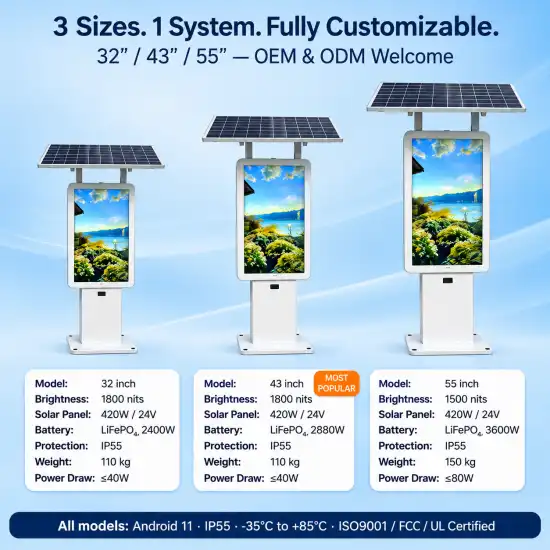
Topview T32SO, T43SO, T49SO, and T55SO Solar Panel Outdoor Digital Signage
Sunlight-Readable Display and Glass
The T32SO, T43SO, T49SO, and T55SO series include a high-brightness LED-backlit LCD display with a resolution of up to 1920 x 1080 and a brightness of 1500 or 2000 nits. The working temperature range of the LCD substrate is -30°C to 110°C, allowing rapid starting under frigid conditions. Imported US-produced AR glass is 6 to 10 mm thick and UV- and IR-resistant and heat-insulating. The glass is 6 mm double-sided laminated glass with anti-glare treatment and vandal resistance. It transmits over 97 percent of light, reflects less than 3 percent, and blocks 99.99 percent and 52 percent of UV and Solar Panel Outdoor Digital Signage radiation heat, respectively. A photosensitive probe will automatically adjust the brightness.
Cabinet, Cooling, and Power Control
The cabinet is made of 1.5 mm galvanized steel with external powder coating. Color is customizable. The shell has a life expectancy of more than 7 years and is designed to be rainproof, waterproof, and dustproof. Outdoor LCDs heat up fast due to direct sun; thus, the screen is protected by a built-in device, military-grade heat dissipation withtechnology. The smart air temperature management technology operates in -20°C to 45°C conditions, maintains the interior temperature between 5°C and 25°C, and avoids LCD blackening in direct sunshine. High-accuracy filter for limiting dust. The electric control system is equipped with a circuit breaker, segmented timer control, and automated power on and off.
Certifications, Terms, and Support
The series is CE, RoHS, and FCC certified. Price terms: EXW, FOB, DDP. Payment: T/T. Units are packed in hardwood boxes with reinforcement. Lead time is 5 to 15 working days. The standard guarantee is 1 year, with up to 3 years and lifetime technical assistance offered. Optional: Interactive multi-touch screen industrial control computer. Topview has been producing LCD advertising displays in Shenzhen for more than 13 years. Our workshop is 2000 square meters, and we have three manufacturing lines, with a daily output of up to 100 items. Our R&D team comprises at least 10 engineers. We can accept OEM and ODM projects without an MOQ request for modification.
Installation, Applications, and Procurement for Solar Digital Signage
Installation and Maintenance Requirements
A proper installation begins with a site study. Check for sun exposure, shade, wind load, ground conditions, drainage, viewing distance, security, and network connectivity. The format is important also, since a pole-mounted sign, kiosk, or bus stop unit each needs separate foundations and service access. Point the panels to get the greatest sun throughout the year. Installers should be left to perform the grounding, overvoltage protection, weatherproof connections, lockable enclosures, etc., and then test charge, brightness, connectivity, scheduling, and emergency shutdown before handover. “Maintenance is kept light. Dust, pollen or snow may obstruct sunlight from clean panels. Check seals, filters, cables, and fasteners. Monitor battery voltage and controller alarms. Document spare parts and response times.
Business Applications for Solar Digital Signage
Solar digital signage is ideal for distant, scattered, and temporary venues. Parking facilities display availability, cost, and instructions. Transit operators publish routes, arrival times, and service warnings at stations. Where permanent electricity is not yet available, construction businesses communicate safety standards and project renderings. Used by retailers, resorts, schools, towns and developers for marketing, na,vigation and tourist information. Autonomous operation reduces civil works and maintenance travel in parks, rural roads, and event areas. For distributors, a product that doesn’t need wiring is simpler to convey to the end user. It may take one utility dependency out of the project timeline for system integrators and EPC contractors.
Cost, ROI, and How to Choose Solar Digital Signage
Cost varies based on display specs, solar capacity, battery autonomy, enclosure design, connection, certifications, logistics, and after-sales support. Compare lifespan cost. A cheap initial purchase price might disguise increased battery replacement and servicing expenses. The return might include advertising income, reduced grid-extension labor, fewer manual updates, and improved customer communication. Match brightness and screen size to viewing distance and sunshine, design the energy system for the worst month, and ensure IP protection, thermal control, and vandal resistance. If you are ordering for many sites or as an OEM, inquire about manufacturing consistency, documentation, and servicing capacity. Create an RFQ with Location, Size, Brightness, Hours, backup days, connectivity, and Quantity.
Conclusion
Solar digital signage integrates solar panels, a charge controller, a battery, power converters, a weatherproof display, and content software into one system. The important challenge is correct sizing: daily energy demand, local solar hours, and the number of backup days dictate the array and battery. Solar devices save most of the trenching and utility work of grid-powered signs, but generally at a higher initial cost; therefore, lifespan cost is a better measure. The installation is site-specific, and maintenance generally consists of cleaning, inspection, and monitoring of the panels. The outdoor performance of a sign is determined by display brightness, glass quality, cooling, and enclosure protection. Buyers who fit these characteristics for the location may choose a unit with confidence.
FAQ
1. Does solar digital signage work at night and on cloudy days?
Yes. The battery stores daytime energy and powers the display after dark. Runtime on cloudy days depends on battery capacity, brightness, and operating hours, so the design must include the backup days you need.
2. Can a solar sign run fully off-grid?
Yes, when the panels and battery match the load and the local sun. The Topview T32SO, T43SO, T49SO, and T55SO series run on solar energy with no wiring or electrical connections.
3. What maintenance does a solar sign need?
Clean the panels when dust, pollen, or snow builds up. Inspect seals, filters, and cables, and monitor battery status. Topview also provides lifetime technical support after the warranty ends.
4. What should I include in a quotation request?
Include the installation location, display size, brightness, daily operating hours, backup days, connectivity, quantity, and any OEM or ODM needs. Our engineers use these details to prepare a matching quotation and a power calculation.
5. Is there a minimum order for custom units?
Topview has no MOQ requirement for customization. Logo, color, and software customization are welcome.
Request a Solar Digital Signage Solution from Topview
Topview is a Shenzhen solar digital signage manufacturer with over 13 years of LCD advertising display experience, three production lines, and OEM and ODM support. Send your site details, quantity, and brightness needs to market@tviewdisplay.com, and our engineers will reply with a power calculation, warranty terms, and delivery information.
References
1. Progress in Photovoltaics, "Photovoltaic Degradation Rates—An Analytical Review," 2013
2. National Renewable Energy Laboratory, Solar Radiation Data Manual for Flat-Plate and Concentrating Collectors, 1994
3. International Electrotechnical Commission, IEC 60529: Degrees of Protection Provided by Enclosures (IP Code), 2013
4. Wiley, Handbook of Photovoltaic Science and Engineering, 2nd Edition, 2011
5. American Technical Publishers, Photovoltaic Systems, 3rd Edition, 2012
6. Underwriters Laboratories, UL 1973: Batteries for Use in Stationary and Motive Auxiliary Power Applications, 2018