



How to Choose the Best Outdoor Touch Screen Kiosk for Your Business
To choose the best outdoor touch screen kiosk, start with the site, not the screen. Define where the unit will stand, how many people will use it, and what weather it will face. Then check sunlight readability, touch performance, enclosure protection, thermal control, and power safety. A good outdoor LCD kiosk keeps its brightness, responds to touch in rain or heat, and resists damage. Finally, compare suppliers on production capacity, certifications, customization, lead time, warranty, and support. I wrote this guide from our experience at Topview so you can build a clear specification and request an accurate quote.
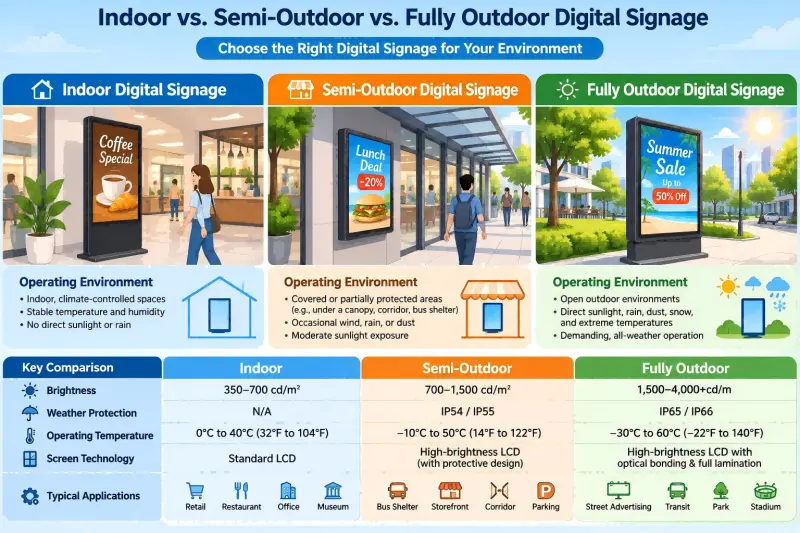
Define Your Outdoor Kiosk Application and Operating Environment
Match the Kiosk to Its Job
A kiosk is subject to a variety of demands, including those for wayfinding, ticketing, ordering, parking, advertising for retail establishments, and providing public information. It is possible for a ticketing unit to get hundreds of touches on a daily basis, but a mall directory generally displays material and manages brief sessions. Using payment methods adds card readers and a higher level of security. The primary job should be written out first, followed by the screen size, mounting method, and software requirements that should be derived from it. Our T32ODF, T43ODF, TP49ODF, TP55ODF, TP65ODF, TP75ODF, and TP86ODF models are compatible with 32, 43, 49, 55, 65, 75, and 86 inches, allowing you to choose a size based on viewing distance rather than only on pricing.
Document Weather, Sun, and Site Conditions
Next, make a note of the orientation of the kiosk. Is there a cover, or has it been left completely open? Keep an eye out for the direction of the sun, precipitation, wind, humidity, dust, salt air, snow, and temperature extremes. The most important factor is sunlight. A reference solar irradiation of about 1,000 W/m2 is established by ASTM G173, which explains why solar panels installed inside wash out and overheat when placed outside. For tougher environments, our devices are designed to withstand temperatures ranging from -40 degrees Celsius to 55 degrees Celsius, and an industrial-grade LCD with a temperature rating of -40 degrees Celsius to 85 degrees Celsius is available as an optional accessory. Your supplier will be able to accurately estimate the thermal system with the aid of a site study that includes images and climatic data.
Plan for Users, Access, and Vandal Risk
Both the weather and the people are important. Take into account gloves, moist hands, and accessibility once you have counted the projected daily users. Unobstructed reach ranges are established by the Americans with Disabilities Act of 2010 (ADA) Standards in the United States. Controls are typically not higher than 48 inches and not lower than 15 inches above the floor. The danger of impact is also present in public places. In addition to having anti-vandal protection, the front of our kiosks is made of 5 millimetres of glass and has an explosion-proof membrane surface. Put all of these requirements into a single checklist that includes dimensions, brightness, mounting, connection, software, certifications, quantity, and delivery area. This will ensure that all of the vendors provide bids that cover the same scope.
Evaluate the Outdoor LCD Display and Sunlight Readability
Brightness Targets for Direct Sun
Brightness is one of the first specifications to check when selecting an outdoor touch LCD kiosk. Typical indoor displays are often too dim for direct sunlight. Our high-brightness LCD screens offer 1,500 to 3,000 cd/m², with a standard maximum brightness of 2,000 nits and an optional 2,500-nit configuration. However, higher brightness is not always necessary. Shaded or semi-outdoor locations may perform well at lower brightness levels, reducing power consumption and heat generation. Match the brightness level to the site's actual sunlight exposure, and ask suppliers whether their stated values represent typical or minimum brightness, as these specifications are not interchangeable.
Glass, Anti-Glare, and Viewing Quality
Glare is controlled by glass in the same way as it is by the backlight. We provide an AR anti-glare glass that is 5 millimetres thick and has a light transmittance of 97% and a reflection of less than 3 percent. Moreover, it has an explosion-proof membrane surface, is laminated, and provides protection against ultraviolet light. Check the contrast, viewing angle, resolution, and viewing distance of the image that is beyond the glass. The pixel spacing of an LCD panel is often finer than that of a standard outdoor LED cabinet, which results in the LCD panel displaying text that is more defined when used for close-range touch. LCD displays are thus a better choice for menus, maps, forms, and payment screens, but LED displays are better suited for watching billboards from a distance.
Auto Brightness and Energy Use
There is no need for full power at sunset for an outdoor screen. A brightness sensor is included in our kiosks, which allows them to adapt their output to daylight. Additionally, the LED backlight that is directly lit utilises automated light detection to save energy. The cooling system is placed under less strain as a result of the lower output, which also results in less heat. The power board is of an industrial quality and can regulate itself based on the brightness to reduce consumption as well. On the power bill, a decreased energy demand adds up over the course of dozens of different locations. Before placing an order, you should enquire about the calibration process of the sensor and whether or not the software allows you to establish minimum and maximum brightness restrictions.
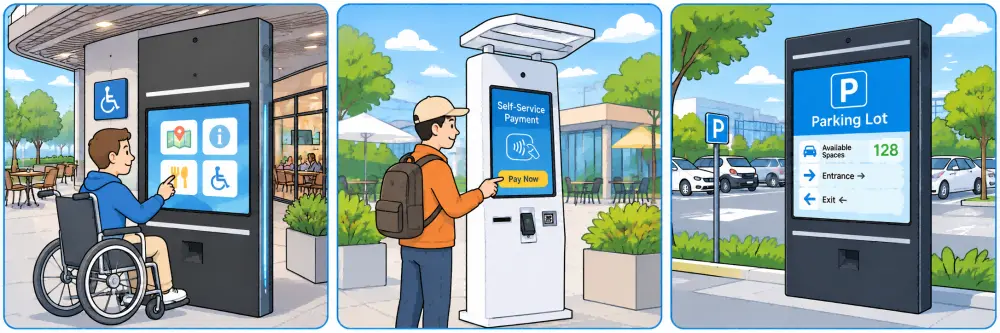
Select the Right Touchscreen Technology and User Interface
Capacitive vs Infrared Touch
After the display has been adjusted to your liking, choose the touch layer. In addition to providing a smartphone-like experience, projected capacitive touch also allows multi-touch, making it suitable for menus, maps, and ordering. When used with gloves or styluses, infrared touch is often more suitable for use with bigger indoor screens. Both have disadvantages when used outside. Infrared frames may be impacted by dirt or intense light if the design is poor, but capacitive sensing can respond to water droplets and may need adjusting in rain. Capacitive sensing can also be affected by noise. If you provide us with information on the user type, the glove usage, and the screen size, we will verify the touch configuration settings for your project.
Protective Glass and Impact Resistance
Because touch layers are positioned behind protective glass, the user experience is influenced by the thickness and quality of the glass. A thicker front is more resistant to impact, but it might alter touch sensitivity; thus, be sure to try both of them together. The International Electrotechnical Commission (IEC) 62262 provides a collective vocabulary for vandal-risk criteria by defining IK codes for impact resistance, ranging from IK00 to IK10. Additionally, you should enquire about the IK rating of the whole front assembly, not just the glass. Our units include front glass that is 5 millimetres thick and has an explosion-proof membrane surface, which provides additional protection against shattering in public areas.
Software and Content Compatibility
An outdoor touch LCD kiosk performs effectively only when its software operates reliably. Confirm compatibility with the operating system, content management platform, browser or application requirements, and peripherals such as card readers, printers, cameras, or barcode scanners. Remote updates and monitoring capabilities are also important, as they can reduce the need for technicians to visit individual outdoor locations. We support customized software configurations and power-on logo customization. Our team can also accommodate specialized devices by designing a customized 3D internal structure for the kiosk. Share your software requirements and system specifications during the initial inquiry to minimize the risk of redesign after sample testing.
Check Build Quality, Thermal Control, and Supplier Capability
Enclosure, Coating, and Power Protection
Enclosure ratings are a good place to start since they provide a standard that is consistent across all suppliers. Both IEC 60529 and NEMA 250 describe the sorts of enclosures that are often used in the United States. IEC 60529 determines the IP codes for dust and water. You should enquire about the rating that is applicable to your specific model and ask for the test paperwork. To ensure that our cabinets have an anti-corrosion performance that lasts for more than ten years, we utilise galvanised steel that has been powder-painted on the outside. On the inside, the electronics are protected from malfunctions by a Taiwan Mean Well industrial-grade power supply, a level 3 lightning arrester with surge protection, and a leakage protection switch.
Heating, Cooling, and Heat Dissipation
The longevity of an outdoor screen is determined by the temperature of the environment. This is a list of the primary thermal benefits that our T-series offers:
- Intelligent temperature control: The unit is able to function in temperatures ranging from -40 degrees Celsius to 55 degrees Celsius thanks to an integrated heating and cooling system that has automated temperature sensing. Additionally, the unit has an air conditioning system that is built in. This makes it easier for multi-site operators to get replacement parts and receive training.
- Proprietary heat dissipation: Our proprietary technique keeps the LCD screen from dimming in direct sunlight, ensuring that text and pictures remain visible even during the warmest hours of the day, when panel temperatures are at their highest. This protection is especially important in locations that face south and get a significant amount of sunlight each day.
- The industrial-grade LCD panel that we provide is rated for temperatures ranging from -40 to 85 degrees Celsius and is available as an alternative for harsh settings. It is possible for project teams to define it at the quote stage, which prevents the need for a cabinet redesign later on in the project and provides engineers with a greater margin of error for airports, transit stops, and other municipal facilities that are exposed.
Because of these qualities, heat danger, which is a primary issue for outdoor installations, is reduced.
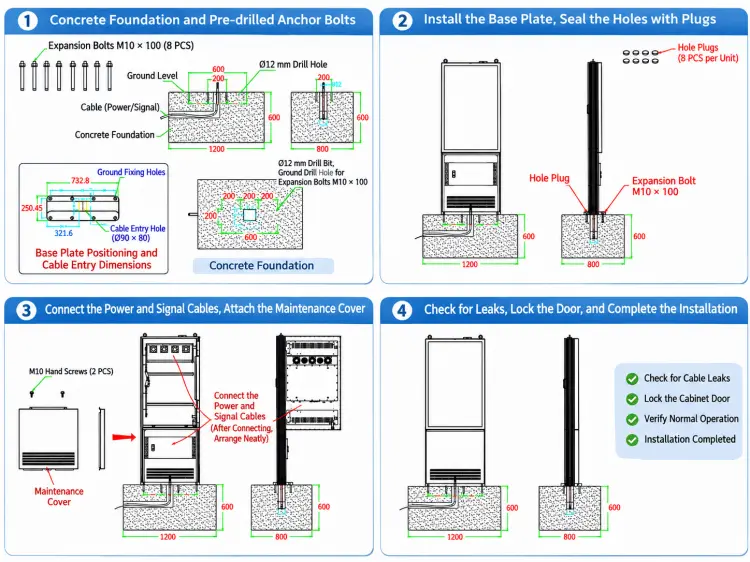
Supplier Capacity, Certifications, and Terms
If the manufacturer is unable to deliver, then a good specification is of little use. Over the course of more than thirteen years, Topview has been manufacturing LCD advertising displays in Shenzhen. A daily output of one hundred pieces is achieved in our workshop that spans 2,000 square meters and is equipped with three manufacturing lines. There are at least ten members on our research and development team, and we have more than twenty senior engineers and assembly personnel working with two after-sales engineers. Because we are the owners of a housing manufacturer, we are open to OEM and ODM projects, as well as silk screen or LED illuminated logos, and we do not need a minimum order quantity for product customisation. The FCC, RoHS, and CE certifications are all included in our products. The conditions of payment are T/T, and the units are sent in reinforced wooden boxes. The terms of payment are EXW, FOB, or DDP. The lead time ranges from five to fifteen workdays, and the warranty is one year by default, up to three years.
Conclusion
Choosing an outdoor touch screen kiosk starts with the application and site, because sun, rain, temperature, users, and vandal risk set every later requirement. Brightness of 1,500 to 2,500 nits, low-reflection glass, and automatic dimming keep an outdoor LCD kiosk readable and efficient. Touch technology must match gloves, water, and glare, and it should be tested behind protective glass. Enclosure ratings, corrosion protection, power safety, and thermal control decide long-term durability. Supplier capacity, certifications, customization, delivery terms, lead time, and warranty then determine whether a specification becomes a working installation. A buyer who documents these points before requesting quotes can compare suppliers fairly and lower technical and purchasing risk.
FAQ
1. How bright should an outdoor kiosk screen be?
It depends on exposure. Direct sun usually calls for a high-brightness panel, and our T-series delivers 1,500 to 2,500 cd/m². Shaded or semi-outdoor sites may need less. Send photos and the sun direction of your site, and our engineers will recommend a suitable level.
2. Can you customize the kiosk for my project?
Yes. We welcome OEM and ODM projects, with no MOQ for customization. You can customize the logo (silk screen or LED backlight), color, power-on logo, and software, and we can build special devices into the kiosk with a new 3D internal structure. Tell us your requirements early.
3. What are your lead time and warranty terms?
Lead time is 5 to 15 workdays, and exact timing depends on quantity and customization. The warranty is 1 year by default, and up to 3 years is available. We quote EXW, FOB, or DDP, accept T/T payment, and pack units in reinforced wooden cases for shipping.
Request an Outdoor LCD Kiosk Quote from Topview
Ready to choose your next outdoor touch screen kiosk? Topview is an outdoor LCD kiosk manufacturer in Shenzhen with 13 years of experience, OEM/ODM support, and 5–15 workday lead times. Send your screen size, site conditions, and quantity to market@tviewdisplay.com, and our engineers will reply with a matched proposal.
References
1. U.S. Access Board, 2010 ADA Standards for Accessible Design, 2010.
2. International Electrotechnical Commission, IEC 60529: Degrees of Protection Provided by Enclosures (IP Code), 2013.
3. International Electrotechnical Commission, IEC 62262: IK Code for Impact Protection of Enclosures, 2002.
4. National Electrical Manufacturers Association, NEMA 250: Enclosures for Electrical Equipment (1000 Volts Maximum), 2020.
5. ASTM International, ASTM G173-03: Standard Tables for Reference Solar Spectral Irradiances, 2020.
6. European Parliament and Council of the European Union, Directive 2011/65/EU on the Restriction of Hazardous Substances (RoHS), 2011.
YOU MAY LIKE
 VIEW MORESmart Solar Furniture Bench
 VIEW MORESolar Integrated table and chair
 VIEW MOREHanging Double -sided Shop Windows Displays
 VIEW MOREDesktop Restaurant Hotel Self Ordering Kiosk
 VIEW MOREOutdoor Wall Mounting Advertising Totem
 VIEW MOREWall-Mounted Outdoor Displays
 VIEW MORESlim outdoor digital totem
 VIEW MOREUlta Slim Wall-Mounted Outdoor Displays