



How Long Can a Solar-Powered Digital Signage Display Operate Without Sunlight?
A suitably sized solar-powered LCD Digital signage device may function for many hours to a few days without sunshine. The precise answer will depend on the usable battery capacity, overall system power demand, brightness, daily usage hours, and the local weather. Most outdoor locations need minimum overnight backup, with multi-day autonomy covering successive overcast days. I always work out the run time for the whole system, not just for the display or the solar panel. This tutorial covers the arithmetic, design considerations, and product attributes that matter when you’re sourcing off-grid outdoor screens.
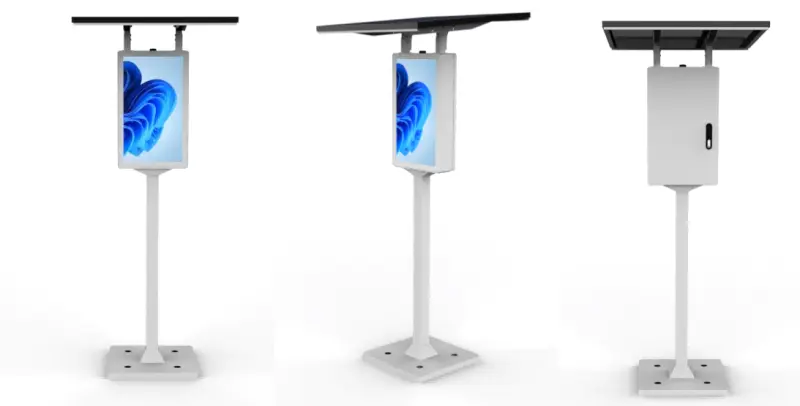
How Long Can a Solar-Powered LCD Display Run Without Sunlight?
The Runtime Formula With a Simple Example
The basic calculation is: expected runtime = usable battery capacity / total system power usage. Assume a system has a 3600 Wh battery (55”)bank and 80 percent of it is usable. then it would still have 2,880 Wh,If the whole system consumes 80 W on average, Set a scheduled power-on/off time for an 8-hour daily operation.of usable energy, which means some 5 days of operation(Given that it will be completely overcast and rainy for these 4–5 days). It can be fully charged in one day if it’s sunny. These values are for illustration only and are not Topview standards. This refers solely to the power consumption and standby time of the display screen based on an Android motherboard solution. Standby time may vary if the motherboard or features are changed, since they all draw from the same battery. Each project requires its own computation. You will modify one input, for example, the size of the screen or the brightness, and the outcome changes immediately.
Why Usable Battery Capacity Is Lower Than the Label
The number you see on a battery is the nameplate rating, but you may practically extract less energy from it. Depth-of-discharge restrictions save battery life; therefore, a controller stops discharging before the cells are exhausted. Cold weather limits available capacity, age diminishes it over the years, and power conversion wastes a tiny portion of the energy. Designers also build in a safety margin for unforeseen weather. IEEE Std 1013 covers size of this kind for stand-alone solar systems. I check for usable capacity in a quote, not nameplate capacity, since it's the only number that forecasts actual run-time.
How Brightness Control and Schedules Extend Runtime
Operating schedules affect autonomy more than most purchasers realize. Everything else being equal, a screen that plays content 12 hours a day uses about half the energy of a screen that runs 24 hours. Our solar-powered systems include a light sensor technology that adjusts the brightness to ambient light, so the screen does not remain at maximum output at twilight or at night. The machines additionally provide illumination control over 10 programmable time slots, letting operators configure the backlight behavior by time of day. Together, these parameters will reduce the daily consumption and extend the time a battery can handle the load.
What Determines Solar Signage Battery Backup Time?
How the System Works Together
A solar-powered outdoor digital signage system is a power station and a screen all in one cabinet. The photovoltaic panels gather the sunshine, the charge controller regulates the current, and the battery stores any extra energy. The panels power the display and replenish the battery throughout the day. When it is dark or overcast, the battery takes over. The media player, the cooling parts, and the protective devices all get the same power. Smart controls may dim brightness, or even put the panels into sleep, when the battery hits a certain level, before kicking back into gear once the panels recharge it. They all influence each other; therefore, I see the symbol as one energy system.
Battery Chemistry and Temperature
Battery choice impacts both service life and runtime. Lead-acid batteries are cheaper initially but often have a deeper discharge depth and need more maintenance. Lithium iron phosphate (LiFePO4) batteries usually provide a longer cycle life, larger usable capacity, and superior thermal stability. These trade-offs are discussed in length in reference books such as the Handbook of Batteries. Temperature matters for all types. Cold weather reduces available capacity; most lithium batteries should not be charged below freezing until heated, and heat reduces battery life. If you live in an extremely cold or very hot climate, ask the provider how the temperature of the batteries within the cabinet is regulated.
Solar Input, Seasons, and Energy Balance
The panels have two jobs: operate the display and recharge the battery. If the daily solar harvest is less than the daily use, the battery drains a bit more each day. Solar availability varies by location and month, and the NREL Solar Radiation Data Manual catalogs these variations across the United States. A month in winter may provide far less energy than a summer month. Shading, snow, dust, and tilt of the panel further restrict harvest. IEEE Std 1013 employs the lowest-sunlight period for its design foundation, and I advocate the same method. Don’t size the system for the sunny average; size it for the worst month and for consecutive overcast days.
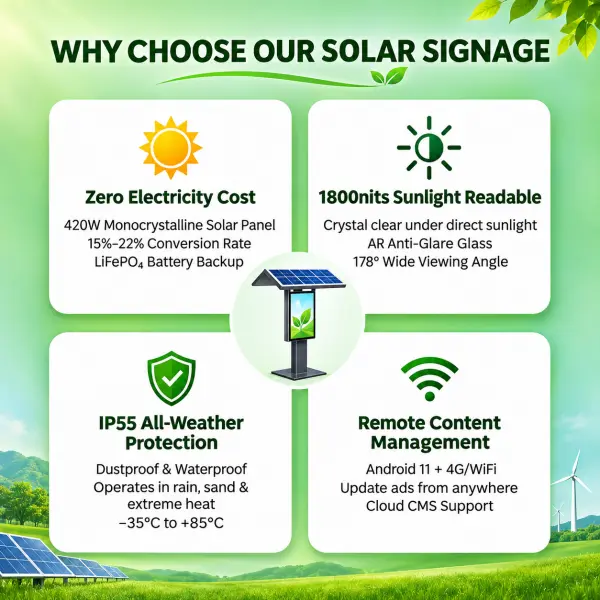
How to Choose an Outdoor Solar-Powered LCD Display
Sunlight Visibility and Weather Protection
Indoor screens wash away in daylight; therefore, an outdoor model requires strong brightness and glare control. Our solar signage battery life comes with a high-brightness LED backlit screen at 1500 or 2000 nits, with a resolution of up to 1920 x 1080. The front has 6 mm anti-reflective tempered laminated glass to increase light transmission and reduce external reflection. The sealed cabinet is rated IP55. That grade, per IEC 60529, is for protection against minor dust intrusion and against water jets, which is good for rain and wind-blown debris. The housing is galvanized or stainless steel with a weather-resistant surface. The device runs from -30°C to +85°C.
Thermal Control, Electrical Protection, and Playback Stability
It’s not only rain that’s damaging to outdoor electronics as heat and wetness. The cabinet is designed with an air-cooling structure, using military-grade aluminum heat-dissipation substrates, and sophisticated temperature management maintains a dry interior to minimize fogging and condensation. Electrical protection includes leakage, overload, overvoltage, lightning, and overtemperature. As far as software is concerned, the player features a hard disk self-check and repair routine. It can survive more than 10,000 forced power-off and reboot cycles without file damage, which is important for any sign that could lose power. Its modular architecture makes it easier to repair, and it has autonomous start-up and shutdown, so there is no need for specialized on-site maintenance workers for the display.
Procurement Checks and Customization at Topview
Most of our project work fails due to planning gaps, not bad parts: sizing for summer only, putting an indoor display outside, neglecting router and cooling demands, and no low-battery strategy. Ask for the total average and peak power, the usable battery capacity, winter assumptions, and warranty conditions before you make your purchase. Also, compare technologies honestly. LCD is good for detailed material at close to medium distances. LED is suited to extremely big, long-distance formats. E-paper requires less electricity for largely static content. Topview has been building LCD advertising displays in Shenzhen for more than 13 years. Our 2,000-square-meter workshop has 3 manufacturing lines, supported by more than 20 senior engineers and assembly personnel, at least 10 R&D professionals, and our own housing factory. OEM & ODM projects are accepted. There is no MOQ for modification.
Conclusion
The runtime without sunshine relies on the whole energy system. A first estimate is usable battery capacity divided by total power use, although nameplate ratings, temperature, age, and conversion losses diminish what a battery provides. You may increase your system’s autonomy by adjusting brightness control and operation schedules. The true limitations are established by the battery chemistry, the amount of solar-powered LCD Digital signage input, and the worst month for sunshine. Visibility, sealing, heat control, and electrical protection affect whether a device continues to function throughout those periods.” Sizing for normal circumstances or disregarding accessory loads leads to common mistakes. So a good estimate takes the real location, screen size, and running hours and considers the display, battery, panels, and controls as one system.
FAQ
1. Can solar signage run 24/7 on battery alone?
Not indefinitely. The panels must recharge the battery, so continuous operation works only when daily solar harvest covers daily consumption. For several cloudy days in a row, designers add battery reserve, lower brightness, or shorten operating hours. The right mix depends on the site, so a project-based calculation gives a firmer answer than a general rule.
2. Does high brightness drain the battery faster?
Yes. A 1500 or 2000 nit backlight draws more power than a dim one, and the backlight takes a large share of a display's power draw. Smart light sensing lowers output as ambient light falls, which saves energy and reduces screen aging. Scheduled backlight control cuts consumption further during low-traffic hours.
3. Can Topview customize a solar-powered LCD display?
Yes. We accept OEM and ODM projects and customize logos by silk screen printing or LED backlighting, along with colors, power-on logos, brightness levels, and software. There is no MOQ requirement for customization. We can also build special devices into the screen through a new internal 3D structure, depending on the project.
Request a Solar-Powered LCD Digital Signage Solution From Topview
Topview is a Shenzhen solar-powered LCD Digital signage manufacturer with 13 years of LCD advertising display experience. Send your screen size, location, daily operating hours, backup duration, and order quantity to market@tviewdisplay.com, and our engineers will recommend a configuration for your project. We welcome OEM, ODM, and private-label requests.
References
1. IEEE Std 1013, IEEE Recommended Practice for Sizing Lead-Acid Batteries for Stand-Alone Photovoltaic (PV) Systems, 2007.
2. IEC 60529, Degrees of Protection Provided by Enclosures (IP Code), 2013.
3. National Renewable Energy Laboratory, Solar Radiation Data Manual for Flat-Plate and Concentrating Collectors, 1994.
4. Linden's Handbook of Batteries, McGraw-Hill, 2011.
5. Solar Energy International, Photovoltaics: Design and Installation Manual, 2004.
6. Solar Electricity Handbook, Greenstream Publishing, 2012.
YOU MAY LIKE
 VIEW MORE21.5/23.8 inch Android 14 L Shaped Restaurant Desktop Menu Board
 VIEW MORE55″ Landscape Transparent OLED Self-Service Touch Kiosk
 VIEW MOREHight Brightness Double-sided Windows Facing Kiosk
 VIEW MOREEmbedded Open Frame LCD Monitor
 VIEW MORESelf Service payment Kiosk
 VIEW MORESolar Panel Waterproof Digital Poster Foldable Portable LCD Advertising Screen
 VIEW MOREOutdoor LCD Totem Signage
 VIEW MOREUlta Slim Wall-Mounted Outdoor Displays