



Solar-Powered Advertising Displays for Parks, Beaches, and Tourist Attractions
Solar-powered advertising displays for parks, beaches, and tourist attractions work best when they run as a complete, off-grid package. Solar powered outdoor digital signage pairs a sunlight-readable screen with a solar panel, a battery, and a sealed outdoor cabinet. It shows maps, safety alerts, event news, and local ads without trenching power lines through sensitive ground. I wrote this guide for park agencies, tourism boards, integrators, distributors, and advertising operators who must pick a system with confidence. Below, I cover how these systems operate, which specifications matter, and how to judge a supplier. I also share what we build at Topview.
How Solar-Powered Outdoor Digital Signage Works at Visitor Sites
The Core Parts of a Solar Digital Signage System
A solar-powered outdoor digital signage system is made up of four main parts. Light from the sun is turned into power by the panels. Another part of the system sends power to the screen and battery. The battery stores extra power so the screen can stay on at night and when it's dark. A closed cabinet keeps things safe from rain, dust, and heat.
Because the unit doesn't need any outside lines or a grid link, crews don't have to dig ditches. Time would be better spent at the beach, in parks, or on trails. Sizes are chosen for each part based on how much power the screen needs and where the sun is. The screen and battery need to be bigger so that they are brighter and last longer. When someone wants to buy something, they always start by telling me the daily hours. That one number sets the tone for the whole design.
How Content, Brightness, and Monitoring Are Managed
There are many ways for things to get to a screen that is far away. A lot of people choose 4G or 5G routers, Wi-Fi, Ethernet, USB drives, and SD cards. A manager can change a playlist from the office with cloud software instead of driving to the site.
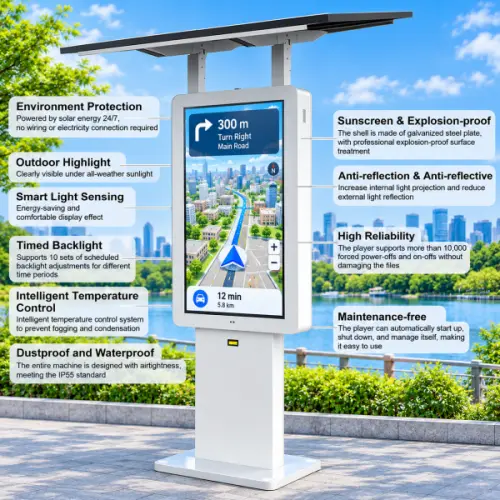
It saves power to change the brightness as well. At night, a screen doesn't need to be on full power, but it should be bright. About 100,000 lux can be reached in direct sunlight. Our units have a light sensor that changes how bright they are based on how bright it is outside. You can also choose from 10 different times for the backlight to turn on and off. This mix cuts down on power loss and slows down the aging of the screen. When buyers get to the site, they can use the built-in standalone or network playback board to pick whether they want to tune in while online or listen to music while connected.
Where Parks, Beaches, and Attractions Use Them
The people who run parks use solar outdoor information screens to show things like trail maps, opening hours, conservation notes, and safety signs. People who own beaches can put up signs about things like changes in the tide, no swimming, weather warnings, and closings. Ad space on the beach can also be bought by shops nearby. Museums, historic sites, and visitor centers all have screens that show guides in more than one language, line updates, and messages from sponsors. Parking lots and exits from afar have signs that show shuttle times, payment steps, and traffic signals.
Each place has a different order. Parks like screens that don't reflect light and are small and easy to move. Things that are bright and won't rust are good for beaches. A lot of the time, businesses need clear pictures for ads and quick changes. If you make sure the design fits the use case, you won't have to pay for space you won't need.
Choosing the Right Display, Power, and Weather Protection
LCD, LED, and Conventional Alternatives
People should not only look at prices, but also think about what they can do with the options. You can see maps and plans clearly on LCD screens, both up close and far away. Large LED billboards are a good way to get your message across over long distances. Plan how much energy to use in places where power is already there with grid-powered screens. Flat signs are a cheap way to show information that doesn't change.
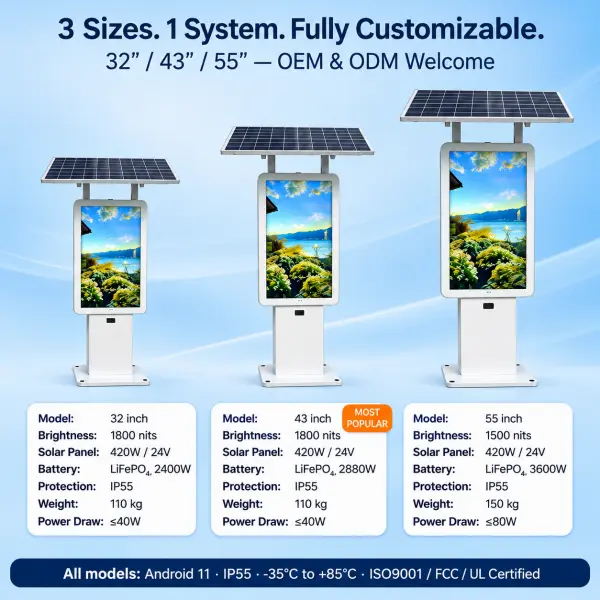
You should use cable-free solar digital signage when it's not possible to dig a hole, the land is sensitive, or you are far from a power line. The battery backup keeps the alert signs going when the power goes out. Most indoor screens are only a few hundred nits bright, but ours have an LED-backlit LCD screen that is 1500 or 2000 nits bright. At that level, you can still read text and pictures during the day.
Topview Screen and Cabinet Specifications
Here are the core features of the Topview outdoor unit.
- Sunlight visibility: The LED-lit LCD screen can get as bright as 1500 or 2000 nits and can show images up to 1920 x 1080. 6 mm tempered anti-reflective glass from abroad lets more light through, cuts down on outside reflections, and keeps UV and infrared heat out. This keeps the panel cooler and the colors bright in direct sunlight.
- Weather and temperature protection: The zinc or stainless steel cabinet has an IP55 rating, which means it can keep water and dust out. The unit can work from -30°C to +85°C thanks to military-grade metal heat-dissipation plates and air cooling. Thermal control that is smart keeps the inside dry so that fogging and condensation don't happen. Protection includes stopping leaks, too much current, too much voltage, lightning, and too high of a temperature.
- Operation and mounting: Nobody needs to be on-site to run the unit because it can start up and shut down on its own. Its player can be turned off and on more than 10,000 times without missing any information. The base is held in place by screwed studs that are driven into the ground. The sound comes from a 2 x 10W audio system.
Sizing the Solar Array, Battery, and Coastal Protection
Sizes should be based on what's available in the area, not on how much sunshine there is on average each year. The maximum is set by the season with the most clouds. An engineer first checks the monitor's power, daily hours, brightness, and internet use. Then they add up how many days of backup there are. A tool at the National Renewable Energy Laboratory called PVWatts can estimate how much energy a place will get from the sun.
Because the project decides the screen and battery size, I suggest writing down the type of cell, how much it can hold, and how far it can reach. It's important to clean screens because bird droppings, dirt, or sand can slow them down.
There is salt spray, humidity, and wind near the coast. IEC 60529 sets the IP codes, and ISO 9227 sets the tests for salt spray corrosion. If it has an IP55 rating, it can keep dust and water jets out. When it comes to beaches, I think you should ask for full details and calculations that take into account how windy it is where you live.
Installation, Planning, and Supplier Selection for Solar Signage
Site Assessment, Installation, and Maintenance
The first step in a good installation of cable-free solar digital signage is to go to the site. In all four seasons, check to see if there is sun, shade, wind, cell phone service, tourist traffic, and access for service crews. After the foundation is put in, the cabinets, the solar panels, the electrical connection, the software setup, and a test during the day and at night are all done in a set order. The pad and pin setup needs to be planned ahead of time so that our units stay in place.
Taking care of yourself is easy. Clean the panels, look for corrosion on the seals, fasteners, and cables, and make sure the screen is bright and hooked up. The unit can be watched from away to see if the battery is low, it's getting too hot, or there are problems with the play before guests see a blank screen if it's online.
Planning, Compliance, and Risk Control
A lot of projects fail because they weren't planned well. They don't think about how much power they'll need, how far away they can see, corrosion, how to connect to the network, or how to clean. For smaller estimates before going bigger, I believe the screen should be read from a real distance, and a pilot unit should be used. This should be done during the season with the least amount of sunlight.
Teams in the US that buy things should also check the rules in their own country. Public places may need to follow the Americans with Disabilities Act Standards for Accessible Design, as well as get city sign permits, meet electrical requirements, and get land-use approvals. The Manual on Uniform Traffic Control Devices may have rules about signs that tell people where to park or about traffic. Before you give the seller the go-ahead, have your expert or tester look over the test results, models, and warranty terms.
How to Choose a Solar-Powered Outdoor Display Supplier
You should get more than just a screen. Check to see if the company has technical experience with solar-powered outdoor digital signage, can build enclosures, and offers content software, documentation, and help after the sale.
Topview has been making LCD signs in Shenzhen for over 13 years. Our shop is 2,000 square meters, and three production lines make 100 units every day. Our team has more than 20 top engineers and people who help put things together. We also have at least 10 researchers and developers and two engineers who work with customers after the sale. We make homes in our own factory, so OEM and ODM projects are welcome. To make changes, you don't need to buy a certain number of units. You can change the names, colors, lights, power-on screens, and software. You should compare all of the quotes you get by looking at the specs, ratings, installation options, warranty, lead time, and shipping terms of each screen.
Conclusion
These solar powered outdoor digital signage billboards don't need to be buried or wired into the power grid, so they're good for parks, beaches, and tourist spots. But they can still show ads, maps, and alerts. It should have a bright screen that doesn't reflect light, panels and batteries that are the right size, and a box that is safe and can handle dust, water, and temperature changes. There needs to be extra corrosion protection along the coast when there isn't as much sun. Options with LCD, LED, grid power, and static can all work. Which one to use depends on how far away you are looking, what the site is about, and how it works. Careful site assessment, planning, and simple maintenance are all that a unit needs to keep running. As important as the unit's price is the supplier's technical depth, paperwork, and customer service.
FAQ
1. Can the display be read in direct sunlight?
Yes. Antireflective glass keeps glare from coming in from the outside, and the screen can get as bright as 1500 or 2000 nits. It also changes how bright it is based on how much light there is.
2. Does the unit need a grid connection or cabling?
No, it doesn't need any wires or a connection to the grid because it gets its power from the sun. Putting screwed studs into the ground around the base keeps it in place.
3. How does it handle rain, dust, and cold?
The cabinet has an IP55 rating, and the unit can work in temperatures from -30°C to +85°C. Smart temperature control helps keep the screen clear and free of condensation.
4. Can I order units under my own brand?
Yes. We can make changes to the name, color, brightness, power-on screen, and software. We are also open to OEM and ODM projects. There is no minimum order number (MOQ) for making changes.
5. What should I include in a quote request?
Tell us where the site is, what the weather is like, how big the screen is, how far away it is to view, what hours it's open every day, how much is needed, if it needs to be connected, and where it needs to be delivered.
Contact Topview for Solar Powered Outdoor Digital Signage Projects
Topview is a solar powered outdoor digital signage company in Shenzhen that uses solar power. They've been making LCD screens for 13 years, have 3 production lines, and can make 100 units a day. When you want to make changes, there is no minimum order quantity (MOQ). We are happy to work on OEM and ODM projects. We will get back to you with options after you email market@tviewdisplay.com with information about your site, the size of the screen you want, and the number of units you want.
References
1. International Electrotechnical Commission, IEC 60529: Degrees of Protection Provided by Enclosures (IP Code), 2013.
2. International Organization for Standardization, ISO 9227: Corrosion Tests in Artificial Atmospheres – Salt Spray Tests, 2022.
3. National Renewable Energy Laboratory, PVWatts Version 5 Manual, 2014.
4. Solar Energy Industries Association and Wood Mackenzie, U.S. Solar Market Insight Report, 2024.
5. U.S. Department of Justice, 2010 ADA Standards for Accessible Design, 2010.
6. Federal Highway Administration, Manual on Uniform Traffic Control Devices, 11th Edition, 2023.
YOU MAY LIKE
 VIEW MOREoptical display bonding
 VIEW MOREUltra Thin Super Slim Display Indoor Digital Display Screen
 VIEW MORE22inch Rotate Interactive 3D HoloBox
 VIEW MORENewspaper Rack Indoor Advertising Digital Signage
 VIEW MOREWifi Rotate Screen Lcd Totem Signage
 VIEW MORESelf Service payment Kiosk
 VIEW MOREoutdoor ev charging kiosk
 VIEW MOREFan Cooled Outdoor Kiosk